Pulling the BI-48 from its custom surround worried us. They planned the pull, protected the millwork and reseated the panel perfectly — fan replacement $610, cabinetry untouched.
Homeowner, Fremont HillsClimate care field guide · Cabinet-safe service
Pulling a built-in Sub-Zero without leaving a mark on your cabinetry
When a built-in Sub-Zero in Los Altos Hills throws a control-board fault, a thermistor error or a display alarm, the diagnosis often lives behind the unit — so the column has to come out of its custom surround. That is the part owners worry about, and rightly: the cabinetry here costs more than the appliance. We are a Sub-Zero-focused service, and the same care we take on jobs over in Saratoga applies here — we plan the pull, protect the millwork, and reseat to alignment.
This page is about that handling: how the unit comes out, and what we genuinely can and cannot claim.
Flat $99 diagnostic, credited toward an approved repair.

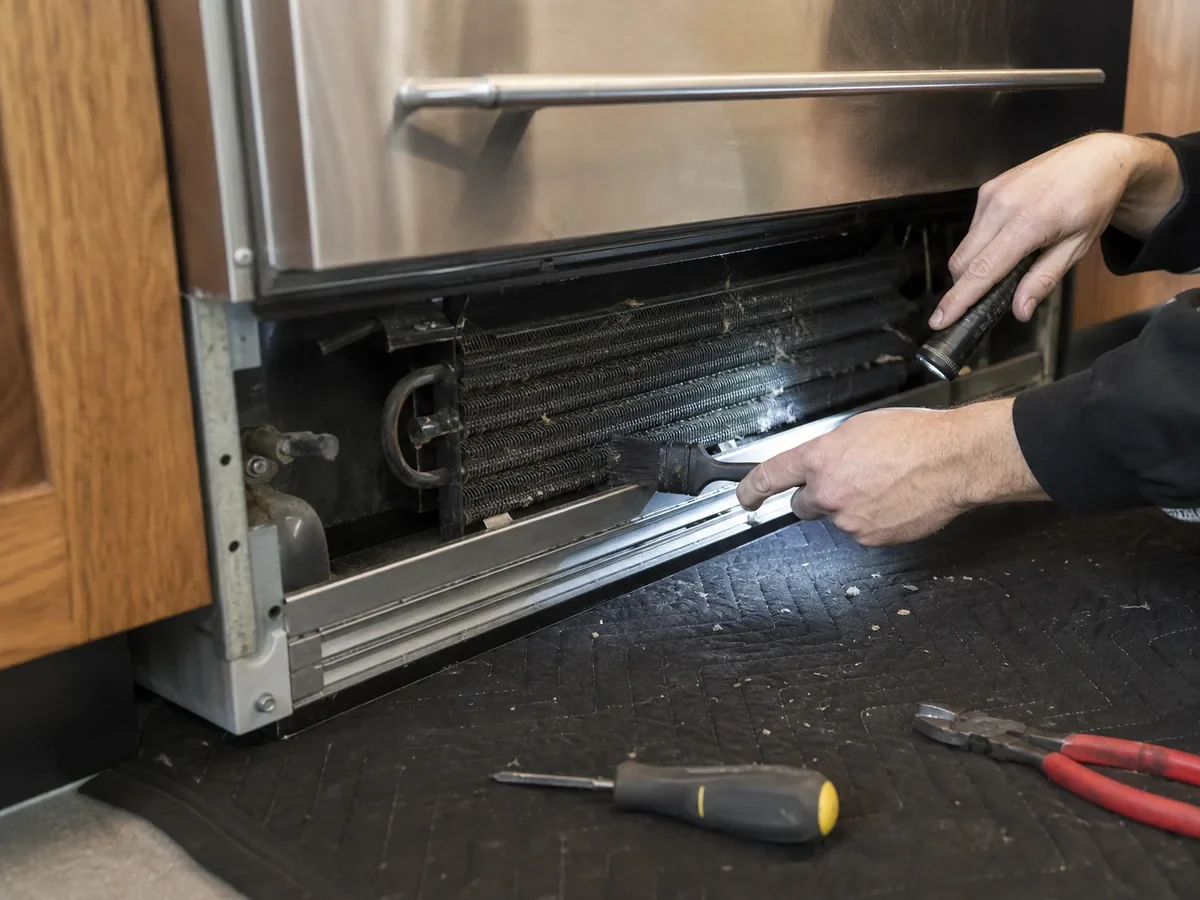
Work-process photo: lower access open, tools and floor protection visible.
Direct answer
Yes — a built-in Sub-Zero can be pulled for service and reseated without damaging the surrounding cabinetry, but it takes a planned removal, not a heave on the door. We disconnect water and power, protect the floor and adjacent millwork, walk the column out on its rollers or a skid, and re-level it to the original reveal before reconnecting. A flat $99 diagnostic is credited toward an approved repair; most repairs run $300–$850, and sealed-system or compressor work can reach $1,400–$2,900. Exact pricing is confirmed on site after diagnosis.
- Cabinet-safe Sub-Zero service in Los Altos Hills: $99 diagnostic, cabinet-safe pull & reseat labor $300–$640, plus the part — fan $360–$740, board $520–$850.
- Many faults are diagnosed without a full pull; when a pull is needed the reveal, grille and panel are photographed and realigned.
- In estate kitchens the cabinetry often costs more than the appliance, so millwork protection is planned before the unit moves.
Why the pull matters · 01
A warm fresh-food side can still mean a trip behind the column
The most common reason we end up moving a built-in isn't a dramatic failure — it's a fresh-food section that is warm while the freezer still holds rock-solid. On dual-refrigeration Sub-Zeros the two compartments run on separate sealed systems, so that split tells us the fresh-food evaporator fan, a frosted coil, a defrost component or a thermistor is the suspect, not the compressor. We confirm it with compartment temperature readings and an airflow check at the evaporator before naming a part. The honest limit: some of those components sit behind the rear panel or in the upper machine compartment, and on certain Designer and integrated columns we can't fully inspect them — or reach the condenser to read its true condition — until the unit is eased out of the cabinet. So the pull isn't optional theater; it's how the real cause gets seen.
This is exactly why we ask you to call with the Sub-Zero model number first. The model and serial tell us whether yours rolls out on factory casters, sits on a skid, or is anchored to the cabinet — and that changes how we protect the millwork on the day.
Cabinet-safe pull · The handling · 02
How the column comes out — and goes back to the same reveal
These are the steps that keep a service pull from becoming a cabinetry repair. Each one is about the millwork as much as the appliance.
Photograph the install first
Before anything moves, we shoot the reveal gaps, the grille, the toe-kick and the panel alignment. That record is how we prove the cabinetry left looking exactly as it arrived — and how we reset the unit to the same lines.
Isolate water and power
Shut the saddle or quarter-turn valve, relieve the line, and unplug or kill the dedicated circuit. On integrated units the water connection is often the part most likely to weep onto a cabinet floor if rushed.
Mask the contact surfaces
Adhesive-free protection on the flooring and on both flanking cabinet stiles. Hardwood and stone here scratch on the first slide, so the barrier goes down before the column is touched.
Release the anchors and grille
Remove the upper grille, back out the cabinet anchor screws and free any anti-tip bracket. We note the screw positions so the reseat lands in the original holes, not new ones.
Walk it out level
Roll the unit on factory casters or skid it on a hard board — never drag it by the door or a panel. Two-person handling keeps the weight off the hinges and the panel fronts.
Service with the column clear
With the back and machine compartment exposed, we read the condenser, evaporator and board, then replace the confirmed part. The pull is what makes an honest diagnosis possible.
Reseat and re-level to the reveal
Slide back in, re-level so the doors close square, reset the reveal to the first photo, reconnect water and power, and watch for the first cooling cycle before we leave.
Not every built-in reseats perfectly the first time. Doors that were already sagging on worn hinges, or panels that were never square to begin with, may need a separate alignment pass — and on very old installs a cabinet anchor can be stripped before we ever arrive. We tell you that on site rather than forcing a fit and hoping the gap closes.

Local routing · 03
Why a Mountain View column and a Los Altos Hills column aren't the same call
We service the same Sub-Zero models across the foothills and down into the flats around Mountain View, and the appliance is identical — but the job isn't. A Mountain View built-in often sits in a tighter mid-century kitchen with a shorter, flatter approach: the unit can frequently be rolled straight out to a nearby door. Up in the Los Altos Hills estates, the same column may be at the end of a long private drive, on a stone floor, inside newer panel-ready millwork that hasn't aged into its gaps yet. Newer cabinetry is less forgiving of a careless slide, and the routing — gate, drive, threshold — eats into the appointment window.
So the local factor here isn't weather, it's access and the age of the install. We plan the path to the truck and the floor protection before the visit, which is the other reason the model number and a clear arrival window matter for these homes.
Trust proof · What you keep · 04
What is documented after the repair
A built-in service should leave a paper trail you can hand to the next technician — or to a future buyer of the house. Here is what we put in writing.
OEM parts policy
Parts are genuine Sub-Zero OEM, matched to your model and serial. We keep the original packaging as evidence of what went in, and the invoice names the exact part number — not a generic "refrigeration part" line. We don't use "best parts" language because the serial, not an adjective, decides the part.
Warranty wording
A workmanship warranty covers the labor on the repair we performed, and the genuine part carries its own manufacturer coverage. We state the duration and the limits in writing — what is covered, and what a new, unrelated failure is not — so there's no implied lifetime promise.
Invoice expectations
Your invoice lists the model and serial, the diagnosis, the part fitted and its number, labor, the $99 diagnostic credited, and before/after compartment temperatures. Sealed-system or refrigerant work is logged as EPA Section 608 work. Nothing is ordered before you approve the written quote.
Evidence we capture · 05
A slow ice maker is a small repair — but the proof is the point
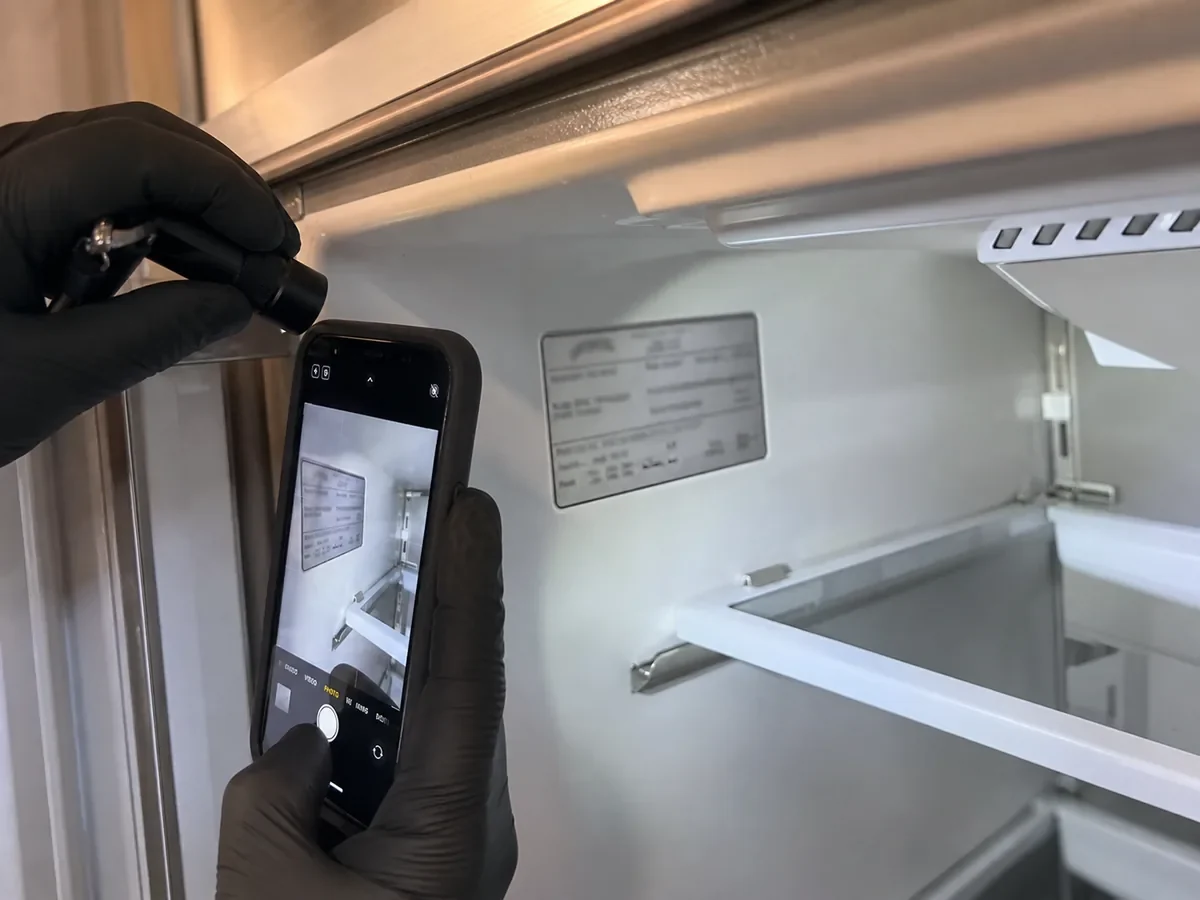
Take a common built-in complaint: an ice maker that is slow, jammed, or dropping hollow, half-formed cubes. It's rarely a serious failure — usually a kinked or frozen fill tube, a tired inlet valve, or a water filter months overdue — and it almost never needs the column pulled. But it's a good example of how we document, because the fix is easy to oversell without measurements. So we measure the actual fill volume, check the inlet valve, and photograph the fill tube and a before/after cube. On the same visit we capture the kind of evidence every built-in job leaves behind: compartment temperature readings, condenser and evaporator photos, a model-tag photo that pins the exact part, and the OEM fan, gasket or control-board packaging kept as proof of what was installed.
You get readings and images, not adjectives. If a homeowner near 94022 later moves and the new owner asks what was done to the Sub-Zero, the invoice and photos answer it.
OEM categories · Parts that must match · 06
Five Sub-Zero part categories where the serial decides the part
On a built-in, two units that look identical from the front can take different parts inside. These five categories are where serial matching stops a near-miss substitute from drifting again next summer.
- Evaporator and condenser fans
- The motor that moves cold air over the fresh-food coil, and the one that pulls room air across the condenser. Sub-Zero revised fan motors and blade profiles across Classic, Designer and PRO runs — a serial-matched fan holds the airflow the cabinet was designed around, where a generic equivalent can run loud or under-move air and re-create the warm-side complaint.
- Door gaskets and panel seals
- The magnetic perimeter gasket that seals warm room air out. Profiles differ by model family and even by door height, so the gasket has to be cut and cornered for your exact unit. The wrong section seals at the hinge and gaps at the latch — exactly the frost line and condensation it was meant to stop.
- Control boards and user interface
- The main control and the display module that throws the alarm in the first place. Board revisions are serial-specific, and firmware behavior changes between runs; fitting the board the serial calls for is the difference between a cleared fault and a unit that reads the cabinet wrong all over again.
- Thermistors and sensors
- The small temperature probes feeding the control its readings. They look interchangeable but carry different resistance curves; a near-equivalent sensor reports a few degrees off, and the board then over- or under-cools. We match the sensor to the serial and verify resistance, not just the connector.
- Water valves, filters and ice components
- The inlet valve, fill tube, filter housing and ice module behind a slow or hollow-cube ice maker. Flow specs and module variants vary across built-in and integrated units, so matching by serial keeps the fill volume — and the cube — to factory shape.
Compliance · Plain about credentials · 07
What we claim, and what we don't
Trust on a page like this is mostly about what a business refuses to overstate.
- EPA Section 608 for sealed systems. Any refrigerant or sealed-system work follows EPA Section 608 rules — the one credential that is legally required, and the one we will name on the invoice when that work is performed.
- Genuine OEM, matched to serial. Parts are genuine Sub-Zero, sourced to your model and serial, with packaging kept as evidence — no "best parts" claims standing in for a part number.
- Written before work. A written quote precedes any repair, and the $99 diagnostic is credited toward the work you approve. We don't order a part before you say yes.
- No invented proof. The photos on this site are illustrative context, not claims about your specific job. We don't post invented reviews, named technicians or addresses to look bigger than we are.
If a board, sensor or sealed system is involved, we verify before we quote and before we pull. A wrong guess on these is the most expensive kind — both in parts and in a second cabinet pull — so we confirm with meter readings, resistance checks and a model-specific reference, or we tell you it needs a specialist step.
Pricing
Cabinet-safe Sub-Zero built-in service pricing in Los Altos Hills
| Service / symptom | What's included | Price range | Time |
|---|---|---|---|
| Diagnostic visit | Model/serial ID, temperature + airflow readings, written findings | $99 (credited to repair) | 45–90 min |
| Cabinet-safe pull & reseat | Floor/millwork protection, two-person pull, panel realign | $300–$640 (labor) | 2–4 hrs |
| Door gasket / seal replacement | Serial-matched gasket, seat and leak test | $300–$640 | 1–3 hrs |
| Evaporator fan motor | Serial-matched fan motor, airflow verification | $360–$740 | 1–3 hrs |
| Control board (serial-matched) | Output test, serial-matched board, verification | $520–$850 | 1–4 hrs |
What sets the final number: the exact model and serial revision, whether the unit must be pulled from its custom cabinet, and parts availability — all confirmed on site after the $99 diagnostic.
After the diagnosis, not before
Call or book online
Call or book online with the model and serial from the tag inside the door, along with what the unit is doing. We'll tell you whether the fix needs the column pulled, how we'll protect the cabinetry if it does, and the honest range before anyone touches the millwork.
Questions · 08
Cabinet-safe service questions we get in Los Altos Hills
Will pulling my built-in Sub-Zero damage the surrounding cabinetry?
Not when it's planned. We photograph the install, mask the flooring and the flanking cabinet stiles, release the anchors and grille, and walk the column out on casters or a skid rather than dragging it by a door or panel. On reseat we re-level to the same reveal the photos show. The cabinetry is treated as part of the job, not collateral.
Do you always have to remove the unit to fix it?
No. Ice-maker, gasket, filter and many sensor jobs are done from the front with the column in place. We pull the unit only when the failed part lives behind the rear panel or in the machine compartment — a frosted evaporator, a condenser fan, or a board on certain integrated columns — and we tell you which kind of repair yours is before the visit.
What documentation do I get after the repair?
An invoice listing the model and serial, the diagnosis, the exact OEM part number fitted, labor, the $99 diagnostic credited, and before/after compartment temperatures. You also get the part packaging as proof and photos of the condenser, evaporator and model tag. Sealed-system work is logged as EPA Section 608 work.
What photo proof helps protect cabinets before a pull?
Have cabinet access details ready: grille, toe kick, floor, panel reveal and nearby cabinetry. On site, the technician should photograph reveal gaps and trim before moving the unit. Those images create a baseline for reseating the column and help separate pre-existing alignment issues from service handling.
Can the fault be diagnosed without pulling the built-in?
Sometimes. Gaskets, many ice-maker issues, display alarms, temperature checks and some condenser inspections can start from the front or grille. A pull is needed when the failed part or proof point lives behind the unit or deep in the machine compartment. The model and symptom decide the safest access path.
Can you service a Sub-Zero built-in without pulling it from the cabinet in Los Altos Hills?
Often yes. Many faults — gaskets, sensors, fans reached from the front, condenser cleaning — are handled in place, starting at the $99 diagnostic. When a board or sealed-system repair requires access behind the unit, cabinet-safe pull and reseat labor runs $300–$640, with the millwork protected and the panel realigned.

Keep reading
Where to go next
Local review signal
Google review highlights for Cabinet-safe Sub-Zero built-in service in Los Altos Hills
Owners usually care about the same three things: careful diagnosis, protected cabinetry and a quote that follows evidence.
They diagnosed our 648PRO without a full pull — gasket and alignment for $420. Floor protection down, the reveal photographed first.
Homeowner, Country ClubAn integrated column needed a board behind the unit; a careful two-person pull and reseat, $640. The kitchen looked untouched after.
Estate manager, Altamont