
★★★★★
A genuine serial-matched control board for our BI-48, named on the invoice with a workmanship warranty behind it. No aftermarket guesswork and no vague "best parts" talk — just the exact part number.
Raymond C., Homeowner, Matadero HillsClimate care field guide · Parts & warranty
If a Sub-Zero wine column in your Los Altos Hills home has been drifting several degrees off its set point — say you noticed it after a tasting carried over from a benefit at Westwind Community Barn — the question after diagnosis is simple: which exact part, and what protects the work? On a built-in, the answer is decided by your model and serial, not by a catalog guess.
We are a Sub-Zero-focused service. This page explains how we source genuine OEM parts, what the invoice spells out in plain language, and the honest limits of the workmanship warranty — before you decide.
Flat $99 diagnostic, credited toward an approved repair.
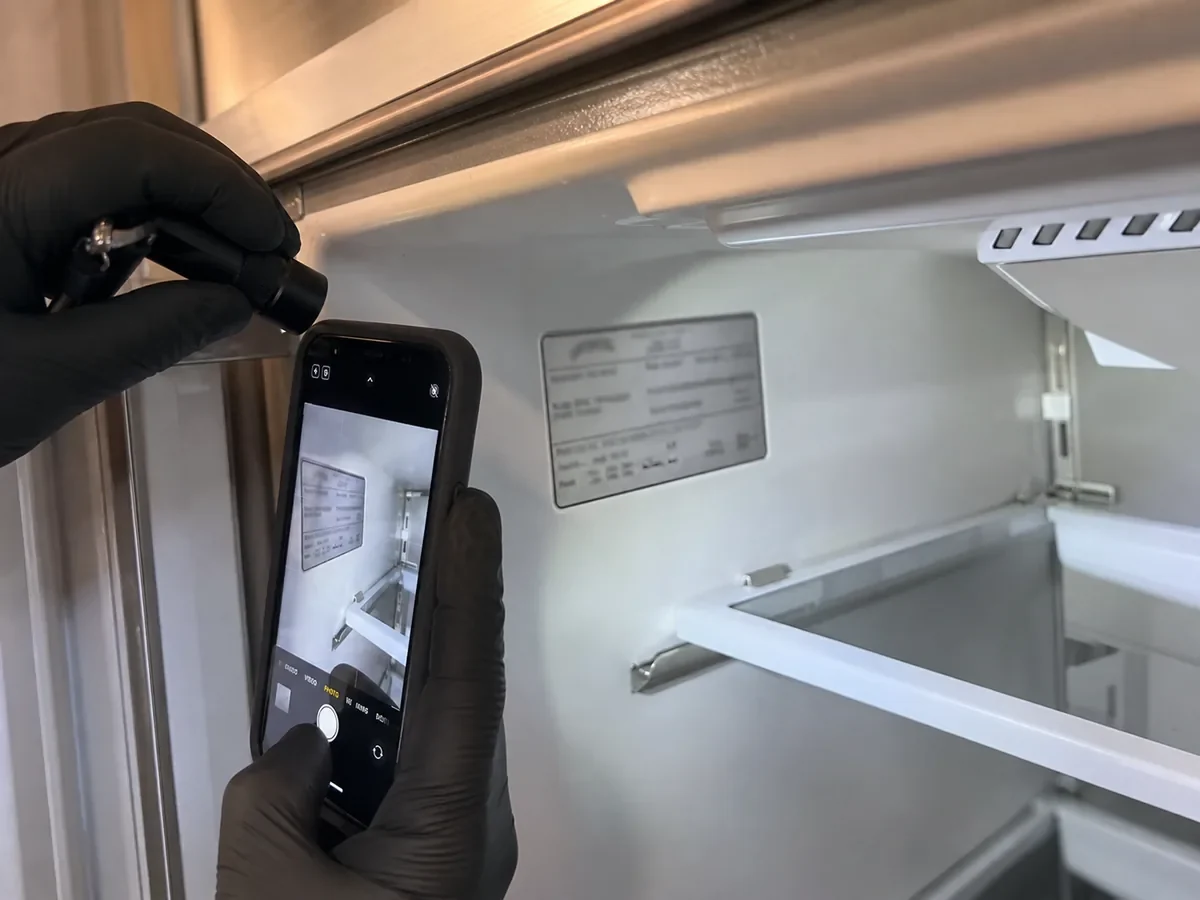
Model/serial photo: accurate part matching starts with the tag.
Yes. Los Altos Hills Sub-Zero Repair still sources genuine OEM compressors, control boards, door gaskets and evaporator fans by model and serial for 15-to-20-year-old built-ins on the 94022 and 94024 estates, then names each part and its workmanship warranty on the invoice. Confirm availability for your unit at (650) 668-1043.
See the Los Altos Hills repair cost and estate-access page for part-and-labor ranges, or weigh longevity on the repair-versus-replace page before ordering.
Direct answer
On a Sub-Zero built-in we fit genuine OEM parts matched to your model and serial — the serial decides the revision, so a near-equivalent is not the same part. The invoice names the part number, the labor, and the readings taken. A workmanship warranty covers our installation; manufacturer part coverage is separate and time-limited. Most repairs run $300–$850; sealed-system or compressor work can reach $1,400–$2,900. The $99 diagnostic is credited toward an approved repair, and the exact quote follows the on-site diagnosis.
When we replace a component on a Sub-Zero — a control board, thermistor, evaporator fan, gasket or inlet valve — the part comes from Sub-Zero’s genuine supply chain, ordered against the model and serial we read on site. We don’t carry a drawer of universal substitutes that “fit most built-ins.” A board for a Classic BI column is not the board for a Designer integrated unit, and the serial often splits a single model into early and late revisions with different parts. That is the whole reason we ask for the tag before the truck is loaded.
The documentation is as much the deliverable as the repair. Every job produces an invoice that names the exact part number fitted, separates parts from labor, and records the temperature readings in each compartment before and after. Where the work touches the sealed system, the invoice notes that it followed EPA Section 608 handling. You keep the OEM part packaging as evidence of what went in. None of this is decoration — it is what lets you, or a future technician, know precisely what is in your unit.
Our warranty covers the labor and the installation: if a part we fitted fails because of how we installed it, or the same diagnosed fault returns within the warranty term, we come back at no additional labor charge. It does not cover a different failure in a different system, damage from a power event, or wear on a part we never touched — and it is separate from any manufacturer warranty on the part itself, which has its own term and its own conditions. We write the term on the invoice rather than quote a number here, because it depends on the part and the work; ask and we will state it plainly before you approve anything.
Boards & sensors · Symptom & part · 02
These three get blamed for each other constantly, and a wrong guess here is the most expensive guess on the unit. Here is how the diagnosis separates them.
A homeowner usually meets this symptom as a display alarm, a flashing temperature, or a unit that reads one thing on the panel while the food tells a different story. The honest part: the alarm points at a component, it does not confirm one. A thermistor (the temperature sensor) that has drifted will feed the control a wrong number, so the board does exactly what it is told and the cabinet ends up warm or cold — the board is innocent. A genuinely failed control board looks similar from the front panel. What separates them is measurement, not the code: we read the thermistor’s resistance against its spec at a known temperature, check the board’s outputs to the fan and defrost circuit, and compare the panel reading to an independent thermometer in the cabinet.
The limitation we state up front: from your description alone we can rank which is more likely, but we cannot confirm a board versus a sensor until we meter both on site. That matters here because a control board is one of the costlier Sub-Zero parts, and serial-matched — so we verify before we order, never the reverse. If the sensor reads in spec and the board’s outputs are dead, the board is named with evidence behind it.
Five categories · Parts catalog · 03
Each category below is a real Sub-Zero part group, with what it does, the failure it causes, and why a serial match is not optional.
The evaporator fan moves cold air through the fresh-food or freezer compartment; the condenser fan pulls heat off the coil up in the grille bay. A stalled or noisy fan shows up as a warm side, a louder hum, or uneven cooling. Sub-Zero fan motors changed blade pitch and mounting across model families, and the serial often distinguishes the variant — a close-looking fan can move the wrong volume of air and the unit drifts again next summer.
The main control board and its relays run the compressors, fans, defrost and the display. A failed board can cause alarms, no cooling, or a unit that won’t respond. These are the parts where serial matching is least negotiable: board revisions differ between Classic, Designer and PRO lines, and even within a model the serial separates firmware and connector layouts.
Thermistors report compartment and evaporator temperature to the board. A drifted sensor produces a cabinet that reads right but runs wrong — the classic cause behind a wine column off its set point. Sensors are inexpensive but model-specific in resistance curve and connector, so the right one is matched to the unit, not approximated.
The magnetic gasket seals the door against warm room air. A hardened or torn gasket lets in humidity, producing a frost line, condensation track, or a sweating door, and makes the system run harder. Gasket profiles and lengths are specific to each door size and model — and on panel-ready built-ins the gasket has to seal correctly behind a custom front, so the exact part matters more, not less.
The water inlet valve and ice module govern fill and ice production. Failures look like slow ice, hollow or partial cubes, or no water. Valve flow rates and module wiring vary across built-in and integrated units, so a serial match keeps the fill volume and cycle timing correct rather than introducing a new symptom.
| Part group | Failure you notice | What the serial pins down | Wrong-part risk |
|---|---|---|---|
| Evaporator fan | Warm side, louder hum | Blade pitch and motor variant | Wrong airflow; drift returns |
| Condenser fan | Compressor runs hot/long | Bay layout and motor rating | Overheating, early failure |
| Control board | Alarm, no response, no cool | Board revision and connectors | Won’t communicate; costly miss |
| Relay / start device | Clicking, won’t start | Compressor-matched device | Compressor stress or damage |
| Thermistor | Reads right, runs wrong | Resistance curve and plug | Persistent drift after repair |
| Door gasket | Frost line, sweating door | Door size and profile | Incomplete seal behind panel |
| Inlet valve | Slow or hollow ice | Flow rate and fitting | Over/under-fill, new symptom |
| Ice module | Jammed or no ice | Module wiring and harness | Cycle timing faults |
Sealed-system and refrigerant handling is performed under EPA Section 608 rules. We do not list a business credential or insurance number on this page unless it is current and verifiable; if you need that confirmation for your records, ask and we will provide what applies before scheduling.
Local routing · 04
Many of the built-ins we service in Los Altos just down the hill are a decade-plus old — established kitchens where the Sub-Zero was specified during the original remodel and never moved. That age is exactly why serial matching earns its keep: a fifteen-year-old Classic column takes parts that are still genuine but no longer the obvious current item, and ordering against the serial avoids a return visit for a part that looked right in a catalog. Where access is tight behind mature millwork, getting the correct part the first time isn’t a convenience — it’s the difference between one visit and three.
Toward Palo Alto, the appliance mix skews newer and more integrated — Designer columns and PRO units behind panel-ready fronts in recently rebuilt kitchens. There the serial matters for the opposite reason: late-revision boards and sensors change faster than the model badge suggests, so the tag, not the look of the unit, names the part. Either route, we confirm model and serial in person before a single part is ordered.
Trust & evidence · 05
This is the symptom that most often ends in a part swap, so it is the one where evidence matters most. On a dual-refrigeration Sub-Zero, a warm fresh-food section while the freezer is still holding points at the fresh-food side — a stalled evaporator fan, a frosted coil, or a drifted thermistor — not the compressor. Before we name a part, we capture temperature readings in both compartments, photograph the condenser and the evaporator (iced or clear), and record the model-tag so the part is matched to the serial. After the repair, we keep the OEM fan, gasket or control-board packaging and re-measure, so the fix is something you can see rather than a claim you have to take on faith.
That evidence trail is also what protects the warranty conversation: if a question comes up later, the invoice, the readings and the packaging say exactly what was diagnosed, what was fitted, and what was verified.
Proof · 06
Pricing
| Genuine OEM part | What's included | Price range | Time |
|---|---|---|---|
| Door gasket / seal | Serial-matched gasket, installed + workmanship warranty | $300–$640 | 1–3 hrs |
| Evaporator fan motor | Serial-matched fan, airflow verified + warranty | $360–$740 | 1–3 hrs |
| Thermistor / sensor | Serial-matched sensor, recalibrated + warranty | $280–$560 | 1–2 hrs |
| Control board | Serial-matched board, outputs verified + warranty | $520–$850 | 1–4 hrs |
| Ice maker module / valve | Serial-matched module or inlet valve + warranty | $300–$720 | 1–3 hrs |
| Compressor (sealed system) | OEM compressor, filter-drier, weighed charge (EPA 608) | $1,900–$2,900 | 4–8 hrs |
Every part is genuine OEM, matched to your model and serial, and named on the invoice with a workmanship warranty.
After the diagnosis, not before
Call or book online before parts are ordered. We’ll confirm the diagnostic path, name the likely part category after evidence is checked, and explain whether repair or, occasionally, replacement is the right call.
Questions · 07
Genuine OEM parts, ordered against your model and serial. We don’t stock universal substitutes that “fit most built-ins,” because the serial often separates a model into revisions with different fans, boards or sensors. The invoice names the exact part number fitted, so you can see precisely what went in.
Our labor and installation: if a part we fitted fails because of how we installed it, or the same diagnosed fault returns within the term, we return at no extra labor charge. It’s separate from the manufacturer’s warranty on the part itself, and it doesn’t cover a different failure, power-event damage, or wear on parts we never touched. The exact term is written on your invoice.
Because Sub-Zero revises parts within a single model, and the serial dates which revision you have — board firmware, fan variants and sensor curves can all change mid-model. Matching to the serial is how we avoid ordering a part that looks right in a catalog but behaves wrong in your unit, which on a built-in usually means a second visit.
An invoice naming the part number and labor separately, the before-and-after temperatures in each compartment, a note where the work followed EPA Section 608 for sealed-system handling, and the OEM part packaging as evidence of what was fitted. The goal is that you — or any future technician — can know exactly what’s in the unit.
We install genuine OEM parts matched to your model and serial. On built-ins the difference is real: a serial-matched evaporator fan or control board behaves to spec, where a near-equivalent can drift or fail early. A board runs $520–$850 and a fan $360–$740, each named on the invoice with a workmanship warranty.
Yes. Many Matadero Hills and Fremont Hills estates run 15-plus-year Classic built-ins, so we source genuine parts for older BI-36, BI-42 and 600-series units by serial. If a part is on backorder we say so before scheduling and quote the range — typically $300–$850 for non-sealed repairs — rather than fitting a wrong substitute.
Keep reading
Local review signal
Owners usually care about the same three things: careful diagnosis, protected cabinetry and a quote that follows evidence.
A genuine serial-matched control board for our BI-48, named on the invoice with a workmanship warranty behind it. No aftermarket guesswork and no vague "best parts" talk — just the exact part number.
Raymond C., Homeowner, Matadero HillsThey matched an evaporator fan to the serial on our 648PRO and kept the OEM packaging as proof of what went in. The paperwork spelled out exactly what changed and why. That kind of record is reassuring.
Janet F., Homeowner, Fremont HillsA door gasket matched to our Designer column and installed the same visit. As they put it, the serial number decides the part, not an adjective. Sealing perfectly months later.
Philip N., Homeowner, near Foothill College