Our BI-36 held the freezer rock-solid but the fresh-food side hit 47 °F. The tech read the model tag, found a stalled evaporator fan motor and replaced it the same visit — $610, about two hours. No compressor scare.
Homeowner, Country ClubClimate care field guide · Not cooling
Your Sub-Zero stopped cooling — start by reading what it's actually doing
"Not cooling" is three different failures wearing one complaint. A Sub-Zero in a Los Altos Hills kitchen can run a fresh-food side warm while the freezer still holds, drift both sides warm at once, or let a wine column creep several degrees — and each points somewhere different. The split tells us where to look before a part is ever named.
Match your symptom in the table below first. It is built to keep you from the two expensive mistakes: condemning a compressor that's fine, or ignoring one that isn't.
Flat $99 diagnostic, credited toward an approved repair.
| What you're seeing | What it usually means | What not to do |
|---|---|---|
| Fresh-food side warm, freezer rock-solid | On dual-refrigeration units, the fresh-food evaporator fan, a frosted coil or a thermistor — almost never the compressor | Don't keep opening the door to check; it loads the warm side further |
| Both compartments warming together | A shared failure: condenser airflow, the main control, or a sealed-system fault that needs qualified sealed-system verification | Don't let it run for days hoping it recovers — move the food |
| Wine column drifting a few degrees off set point | A thermistor, the evaporator fan, or the control reading the cabinet wrong — collectors notice before the wine does | Don't assume the wine is ruined and unplug it |
| Compressor running constantly, never satisfying | A packed condenser starving the system of airflow, or a sealed-system charge issue underneath | Don't pull the unit out yourself to 'get air to it' |
| Display alarm or temperatures flashing | A code flags a component but rarely confirms it — it must be read against the model and serial | Don't trust a generic online code chart for your exact unit |
| Unit silent, no fan, no compressor hum | Power, the main control board, or a start component — not a refrigerant problem | Don't repeatedly cycle the breaker hoping it resets |
| Warm despite a freezer that frosts heavily | A defrost component has failed and the coil has iced over, choking airflow | Don't chip frost with metal or aim a hair dryer at the electronics |
- Typical Sub-Zero not-cooling repair in Los Altos Hills: $99 diagnostic, $300–$850 for fan, sensor or defrost faults, and $1,400–$2,900 for confirmed sealed-system work.
- A cold freezer with a fresh-food side above ~45 °F usually means an evaporator fan, thermistor or frosted coil — not the compressor.
- Oak pollen and foothill dust packing the condenser is the most common avoidable not-cooling cause along the Page Mill corridor.
Direct answer
If a Sub-Zero in Los Altos Hills isn't cooling, the fix depends entirely on which compartment is warm. A warm fresh-food side with a cold freezer is usually a fan, sensor or frosted coil — a $300–$850 repair, not a compressor. Both sides warm can mean the same airflow problems or a sealed-system fault, where EPA Section 608 compliant diagnosis runs $1,400–$2,900 only if the system is actually breached. A flat $99 diagnostic is credited toward an approved repair. Exact pricing is confirmed on site after measurement — we don't quote a compressor from a phone call.
The symptom · Why this page · 01
What "not cooling" actually means on a Sub-Zero
Out toward the open pastures near Westwind Community Barn, the homes that book us tend to share one detail: a high-use, panel-ready Sub-Zero that's the quiet center of the kitchen. When one stops holding temperature, the owner rarely sees a dead box — they see a wine column drifting several degrees past its set point, or a fresh-food side that's gone soft while the ice cream below is still hard. That contrast is the most useful diagnostic clue you can give us, because Sub-Zero built-ins run dual refrigeration — two separate sealed systems — so a warm side and a cold side at the same time tells us the failure is local, not catastrophic.
The second thing owners report is the control board, thermistor or display alarm: a flashing temperature, an alarm tone, or numbers on the panel that don't match the food. In plain terms, the thermistor is the cabinet's thermometer and the board is its brain — if the thermistor lies, the board cools wrong, and the display may show a number that was never true. What confirms which one it is: we read the thermistor's resistance against a temperature chart and compare the board's reading to an independent probe in the same spot. The honest limit — and we say it before we drive out — is that a display code narrows the suspect but can't confirm it. The same alarm can come from a tired sensor or a board that's misreading a healthy one, and only an on-site meter check separates the two.
Ranked causes · The useful part · 02
Likely causes, ranked from simple to expensive
Work down this list — it runs cheapest and most common first. Each cause gives the signs you'd notice, the test we run, and the typical repair. The pattern of which compartment is warm decides where you start.
| Likely cause | Signs you'd notice | How we test it | Typical repair |
|---|---|---|---|
| Condenser coil packed with dust / pet hair | Both sides slowly warming, compressor running nonstop, warm air off the grille | Pull the grille, inspect coil and fan, read compressor draw before cleaning | Clean coil + verify airflow; $300 range if no part failed |
| Fresh-food evaporator fan stalled | Fresh-food side warm, freezer still cold, no airflow felt at the rear vent | Listen and feel for airflow, meter the fan motor and its circuit | Replace evaporator fan motor; $350–$650 |
| Thermistor reading the cabinet wrong | Display number doesn't match the food; one zone over- or under-cools | Read thermistor resistance against the temperature chart, compare to a probe | Replace thermistor; $300–$550 |
| Defrost component failed, coil iced over | Fresh-food warm with a heavily frosted freezer coil behind the panel | Inspect the evaporator for ice, test defrost heater, thermostat and control | Replace defrost part + clear ice; $400–$750 |
| Door gasket leaking warm room air | Sweating door, frost line, edge of the cabinet never quite cold | Inspect the gasket cross-section and door alignment behind the panel | Replace or reseat gasket; $300–$600 |
| Main control board misreading or not commanding cooling | Alarm or flashing temps, components test good but cooling logic is wrong | Compare board output to sensor inputs; confirm against model/serial | Replace control board; $450–$900 |
| Sealed-system / compressor fault | Both sides warm, compressor hot or silent, no recovery after coil cleaning | EPA Section 608 gauge readings on pressures and compressor draw | Sealed-system or compressor work; $1,400–$2,900 |

Why integrated kitchens hide it · Context · 03
The install is why you notice it late
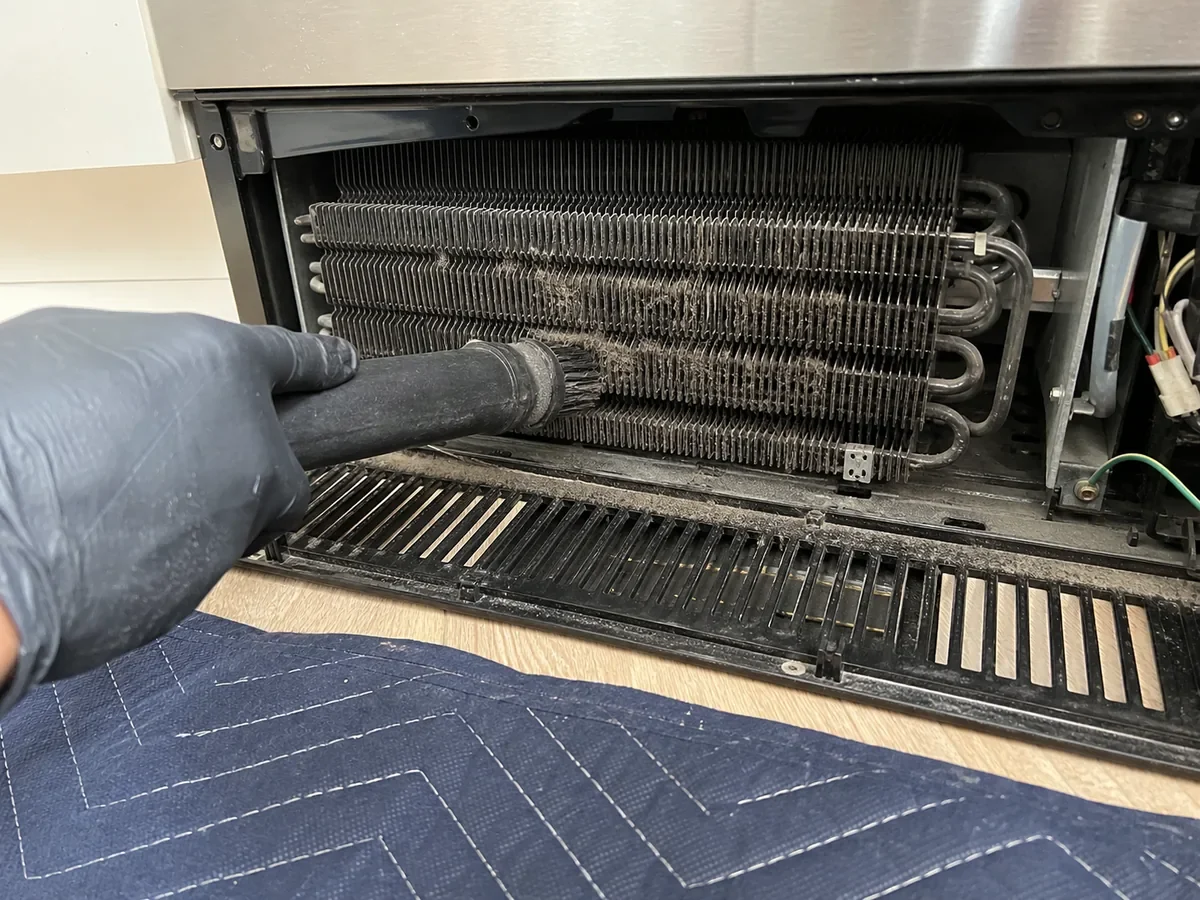
Illustrative context — not a specific job.
In a freestanding fridge you hear the fan and see the coil. In the panel-ready built-ins common to these kitchens, the appliance is sealed behind matching cabinetry, so the early warnings — a fan humming louder, a faint frost line, a condenser you can't see — go unnoticed until the food is already warm. That's why the symptom you hand us matters so much: by the time it's obvious, the cabinetry is hiding the evidence.
It also changes the repair plan. We diagnose before we pull, so a warm fresh-food side doesn't become an excuse to drag the whole column out across new flooring. The model and serial drive that decision — a Classic, a Designer column and a PRO 48 each route their airflow and sensors differently, and a near-miss substitute part doesn't behave the same.
Local routing · 04
Why the route changes the call, not just the address
Most of our not-cooling runs share a corridor with Los Altos just down the hill, which is what makes a warm-side call workable on short notice — a stalled fan or frosted coil can't wait days in a high-use kitchen, and a tight route means a confirmed window instead of a vague half-day. The homes themselves skew toward established remodels with built-ins that have run a decade or more, where the sealed system is sound but a fan, sensor or board has aged out. The fix is usually a part, not a replacement. Pushing further toward Palo Alto, the mix shifts to newer integrated columns and dual-zone wine units, where owners notice a couple of degrees of drift fast and want it logged over a full cycle before anyone names a part — so we plan those visits with time to watch the cabinet, not just glance at it.
What proof looks like · 05
Naming the evidence: a warm fresh-food side, a cold freezer
The single most common pattern we're called for is the fresh-food section warm while the freezer still holds — and it's also the one a generalist most often gets wrong by condemning the compressor. Here's the evidence we capture so the diagnosis is something you can see, not a part we pre-sold. We take temperature readings in both compartments and at the evaporator, so the warm-versus-cold split is on record. We shoot condenser and evaporator photos — the iced or clear coil tells the defrost story at a glance. We read the model and serial tag in person, because the right fan, thermistor or control board for your exact unit is decided by that number, not a catalog guess. And when a part goes in, we keep the OEM fan, gasket or control-board packaging as evidence of what was fitted. You get readings before and after — a freezer that held and a fresh-food side that came back down — not a promise.
Only the bottom row of the ranked table is a sealed-system or compressor failure, and it's the one we will not quote from a description. Both-sides-warm can just as easily be a packed condenser, so we clean and re-measure airflow first. If the system is genuinely breached, refrigerant work falls under EPA Section 608 — gauge readings confirm pressures and compressor draw before any quote. We'd rather tell you it needs that step than swap a $2,000 compressor into a fridge that only needed its coil cleared.
Step by step
Diagnose a Sub-Zero that is not cooling
Note which compartments are warm
Record fresh-food and freezer temperatures and whether one side or both are warm; a cold freezer with a warm fresh-food side points local, not to the compressor.
Check airflow and the condenser
Look for a dust- or pollen-packed condenser behind the grille and listen for the evaporator fan; blocked airflow is the most common Los Altos Hills cause.
Read the model and serial
Photograph the tag inside the door frame so the correct fan, sensor or board revision is matched before the visit.
Measure, don’t guess
On site we meter sensor resistance, verify fan operation and check defrost before naming a part; sealed-system pressures are tested only if simpler causes fail.
Approve a written quote
You get a written range — most repairs $300–$850, sealed-system $1,400–$2,900 — with the $99 diagnostic credited before any work.
Pricing
Sub-Zero not-cooling repair pricing in Los Altos Hills
| Service / symptom | What's included | Price range | Time |
|---|---|---|---|
| Diagnostic visit | Model/serial ID, temperature + airflow readings, written findings | $99 (credited to repair) | 45–90 min |
| Condenser deep-clean & airflow service | Pull-free coil clean, fan check, oak-pollen/dust removal | $230–$460 | 1–2 hrs |
| Evaporator fan motor | Serial-matched fan motor, airflow verification | $360–$740 | 1–3 hrs |
| Thermistor / temperature sensor | Resistance test, serial-matched sensor, recalibration | $280–$560 | 1–2 hrs |
| Defrost system component | Heater/limit/timer test and replacement | $340–$700 | 2–4 hrs |
| Control board (serial-matched) | Output test, serial-matched board, verification | $520–$850 | 1–4 hrs |
| Refrigerant leak + recharge (EPA 608) | Leak isolation, repair, evacuate and weighed charge | $1,400–$2,100 | 3–6 hrs |
| Compressor replacement | Sealed-system pull, compressor, filter-drier, recharge | $1,900–$2,900 | 4–8 hrs + parts |
What sets the final number: the exact model and serial revision, whether the unit must be pulled from its custom cabinet, and parts availability — all confirmed on site after the $99 diagnostic.
After you've matched the symptom, not before
Call or book online
Call or book online with which compartment is warm and the model and serial number from the tag inside the door. That one number tells us the right fan, sensor or board before we leave, so the warm-side fix often happens on the first visit. We'll give you the honest range and confirm the exact figure on site.
Questions · 06
Not-cooling questions we get in Los Altos Hills
My Sub-Zero freezer is fine but the fridge side is warm — is the compressor dead?
Almost certainly not. Dual-refrigeration Sub-Zeros run the two compartments on separate sealed systems, so a cold freezer proves the compressor is working. A warm fresh-food side points to its own evaporator fan, a frosted coil, a defrost component or a thermistor — all far cheaper than a compressor. We confirm with temperature and airflow readings before naming the part.
Both sides of my Sub-Zero are warming up. How worried should I be?
Worried enough to move perishable food, but not to assume the worst. Both-sides-warm most often traces to a condenser packed with dust starving the system of airflow, or the main control — both fixable. A true sealed-system fault is the least common cause and the only one needing EPA Section 608 compliant gauge work by a qualified technician, which we verify on site rather than guess from the symptom.
The display shows an alarm and the temperature is flashing — what does the code mean?
A code narrows the suspect but rarely confirms it, and it must be read against your exact model and serial — generic online charts don't map cleanly to Sub-Zero revisions. The same alarm can come from a failing thermistor or a control board misreading a healthy sensor. We meter the sensor's resistance and compare the board's reading to an independent probe to tell them apart.
How long can I keep using the Sub-Zero before it's diagnosed?
If only the fresh-food side is warm, move anything perishable to the freezer or a backup and stop opening the warm side — it just loads it further. If both sides are warm or the compressor runs nonstop, power down the cooling and relocate the food rather than letting it cycle for days, which stresses the compressor. Then call with the model number so we bring the right part.
What evidence is required before a compressor quote?
A compressor quote requires more than warm temperatures. The technician should document condenser airflow, compressor electrical readings, pressure or leak evidence and the model and serial number before sealed-system work is approved. A packed condenser, failed fan, relay or control issue can mimic a compressor failure, so cheaper false positives are ruled out first.
Can access logistics affect a not-cooling visit in Los Altos Hills?
Yes. Gate access, long driveways, parking, floor protection and panel-ready cabinetry can affect whether the technician can diagnose the unit in a tight route window. Use phone or online booking for access notes, model details and temperatures. The symptom decides the repair path, but the property details decide how safely and quickly the technician reaches the appliance.
Keep reading
Where to go next
Local review signal
Google review highlights for Sub-Zero not-cooling diagnosis in Los Altos Hills
Owners usually care about the same three things: careful diagnosis, protected cabinetry and a quote that follows evidence.
A 648PRO warmed on both sides with the condenser packed in oak dust. They documented airflow first, deep-cleaned the condenser and recalibrated the sensor — $430, 90 minutes. Cooling back to 38 °F before they left.
Homeowner, Page Mill corridorDesigner column drifted to 50 °F. The thermistor was feeding the board a wrong number; replaced and verified over a cycle for $360. They ruled out the sealed system before quoting.
Homeowner, near Foothill College