Our BI-36 flashed a high-temp alarm but felt cold. The thermistor had drifted, not the board — replaced for $300 and the alarm cleared. They read the code against our serial, not a generic chart.
Homeowner, Country ClubClimate care field guide · Technical · Los Altos Hills
Your Sub-Zero is flashing a code or sounding an alarm — read it before you replace anything
A code or alarm on a built-in Sub-Zero points at a component; it almost never confirms one. The same flashing temperature can mean a thermistor, an evaporator fan, a frost-blocked coil or a control board — and the only honest reading is against your model and serial, not a universal chart found online. In Los Altos Hills (94022), most of these units sit panel-ready inside custom millwork, so confirming a code wrong carries a second cost: an unnecessary cabinet pull and reseat. Start with the helper below, then call with the model number on the tag.
We read codes against the serial, not a generic list. Flat $99 diagnostic, credited toward an approved repair.
Direct answer
A flashing temperature, a chime, or a service code on a Sub-Zero built-in is a symptom, not a diagnosis. Codes are revision-specific: a value on a Classic/BI board does not carry the same meaning on a Designer column or a PRO unit, so they must be read against the model and serial. A homeowner can safely note the exact display, check that the unit isn't in a door-ajar or vacation state, and clear a packed condenser — nothing more. Refrigerant, gas-valve, electrical and control-board faults need a trained technician. We confirm a code with a meter or probe before we name a part; a flat $99 diagnostic is credited toward any approved repair.
- Sub-Zero alarm/code repair in Los Altos Hills: thermistor/sensor $280–$560, serial-matched control board $520–$850, after the $99 diagnostic.
- A high-temp alarm on a cabinet that still feels cold is usually a drifted thermistor, not a failed board.
- Codes must be read against the model and serial revision; a generic online chart often points at the wrong part.
Safe for a homeowner: write down the exact display (which compartment, the digits or symbol, whether it flashes or chimes); confirm the door isn't ajar behind its panel; verify the unit isn't in showroom, sabbath or vacation mode; and clear a dust- or pet-hair-packed condenser at the grille. That's the full safe list.
Needs a trained technician — do not DIY: anything touching the sealed system or refrigerant (EPA Section 608 work), gas-valve components, mains wiring, or the control board itself. Pulling the board or jumping a connector to "test" a code can destroy the part you were trying to confirm, and on a panel-ready built-in it usually means an unnecessary cabinet pull. When a code points at the sealed system, we verify with gauges before we quote — see our sealed-system and compressor diagnosis.
Code → component → test · Diagnostic table · 03
What the alarm points at, how we confirm it, and the false positive to avoid
These are the alarm patterns we read most often on Sub-Zero built-ins in the foothills. The display narrows the field; the confirmation test — not the code — names the part. The repair-path ranges are typical, not a quote; the exact figure comes after on-site diagnosis.
| Display / alarm pattern | Possible component | Confirmation test | False positive to avoid | Typical repair path |
|---|---|---|---|---|
| Fresh-food temp flashing, freezer normal (dual-refrig units) | Fresh-food evaporator fan, thermistor, or frosted coil | Compartment temp reading + airflow at the evaporator; thermistor resistance vs. spec | Condemning the compressor — on dual refrigeration the freezer would also be warm | Fan or thermistor swap, or a defrost-component fix; $300–$650 |
| Both compartments warm with an alarm or chime | Sealed system, compressor, or main control | Compressor draw + sealed-system pressures (EPA Section 608 compliant gauges) | Assuming a board fault when refrigerant is low or the compressor is stalled | Sealed-system / compressor work; $1,400–$2,900 after verification |
| Repeating chime with a door symbol | Door switch, hinge alignment, or gasket seal | Switch continuity test + gasket close and frost-line check behind the panel | Replacing the board for what is a $-modest switch or a misaligned panel-ready door | Switch, hinge or gasket repair; $300–$550 |
| High-temp alarm after a power event | Control logic state, sensor, or a recovering load | Clear the alarm, log temps over a full pull-down cycle, re-check sensors | Ordering a board before confirming the unit simply needs to recover | Often no part — sensor check; board only if logged drift persists |
| Ice/water symbol or alarm on units with an ice maker | Inlet valve, fill tube, or ice-maker module sensor | Measure fill volume + valve operation; check module thermistor | Blaming the control for a flow problem the valve or filter is causing | Valve, tube or module repair; $300–$600 — see the ice & water guide |
| Wine column display reading off its set point | Thermistor, evaporator fan, or control reading the cabinet wrong | Set point vs. actual logged over a cycle; thermistor resistance | Replacing the board when a few degrees is a sensor or fan issue | Sensor or fan repair; $300–$650 — drift logged before parts are named |
| Display dark, frozen, or unresponsive | Display ribbon, control board, or power supply | Voltage at the board + display continuity; reseat and re-read the code | Throwing a full board at a loose ribbon or a power-supply fault | Ribbon, supply or board service — confirmed by meter, not by guess |
| Code value not in any homeowner chart | Revision-specific fault — unknown without the serial | Read the code against the service literature for that exact model/serial | Trusting a generic online code list written for a different board | Diagnosis-led: we verify by model/serial before naming the part |

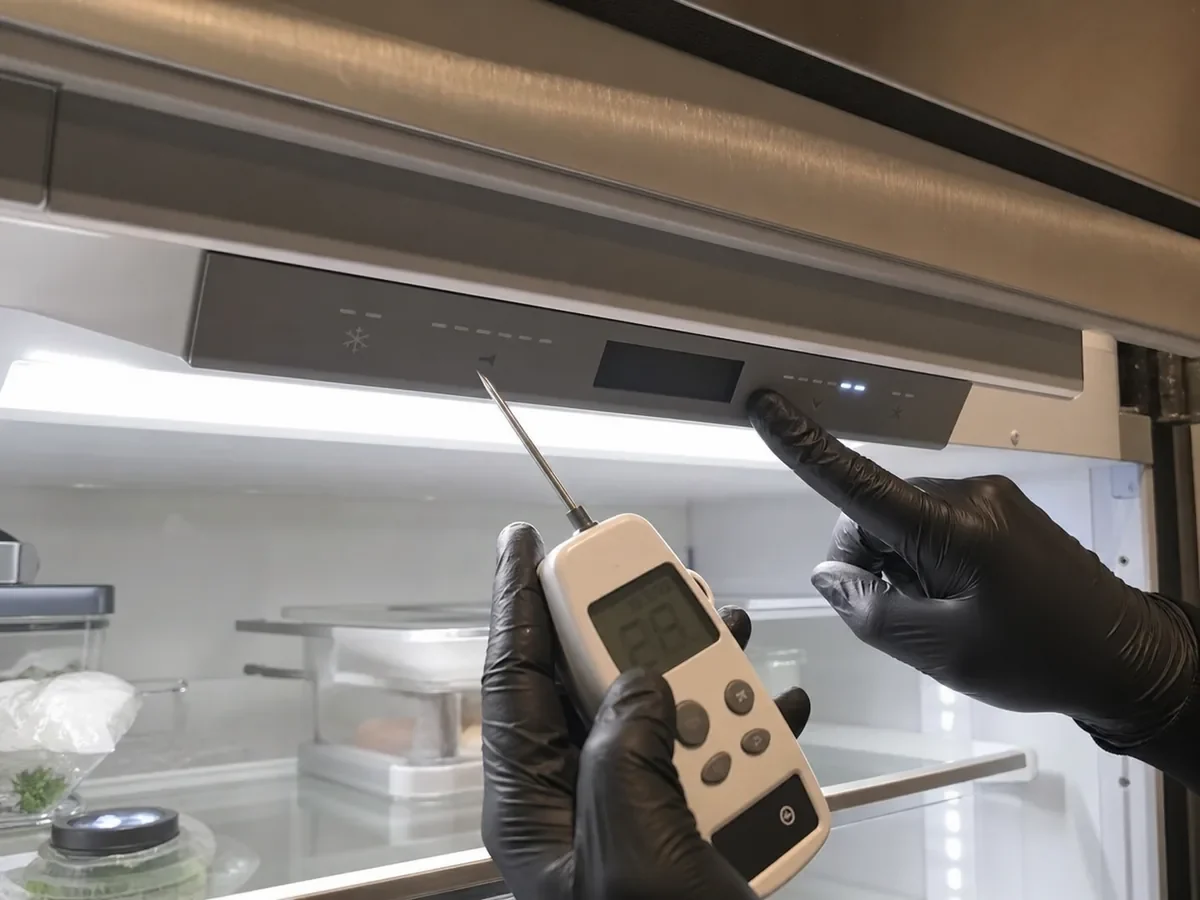
Why the cabinet, not just the code, is the risk in 94022
In the panel-ready kitchens of Los Altos Hills, a Sub-Zero hides behind custom fronts, so the only cheap signal you get is the display. That raises the stakes on reading the code correctly: a wrong call doesn't just waste a part, it triggers a built-in cabinet removal and reseat to reach a component that was never the problem. We plan any pull before touching the unit and reseat panel-ready fronts to alignment — but the better economics is confirming the code first, with a meter, so the unit only comes out once.
The condenser is the alarm hiding in plain sight
A surprising share of high-temp alarms and "warm side" codes trace to a condenser coil packed with dust or pet hair. Under the oaks along the Page Mill foothills, fine pollen and dust load the coil faster than almost anywhere in the valley; a choked condenser makes the compressor run hot and long, and the control reports the temperature it sees as an alarm. What confirms it is direct: we pull the grille, photograph the coil, and re-read compartment temperatures after it's cleared. The honest limit — what we can't know before inspection — is whether clearing the coil fully resolves it or merely unmasks a tired fan or sensor underneath; only a measured recovery cycle tells us, so we log it rather than promise it.
How the install age in 94024 changes the read
Nearer Foothill College in 94024, the housing stock mixes mid-century remodels with newer integrated kitchens, which means the same alarm can sit on a fifteen-year-old Classic board or a current Designer column on the next street. That changes routing and parts more than it changes the symptom: an older serial may need a genuine board or sensor that is no longer the obvious off-the-shelf part, so we confirm the revision before a truck roll rather than after. The address never tells us the answer — the model tag does — which is exactly why we ask for it up front.
What a door-related alarm leaves as evidence
When a chime or door code is really a door gasket leak, condensation or a frost line, the proof is visible, and we capture it: a close-up of the gasket gap and the condensation track, the frost pattern at the seal, and temperature readings showing warm room air leaking past a hardened or torn gasket or a panel-ready door that's drifted out of alignment. We pair that with model-tag proof and keep the OEM gasket, fan or control-board packaging as evidence of exactly what was fitted to your serial. You see the readings and photos before any repair is approved — not an adjective, a record. Around Fremont Hills, where gated drives and recent remodels mean new millwork around the appliance, that gasket-and-alignment read matters most: we'd rather adjust a door than pull a column.
Step by step
Interpret and clear a Sub-Zero error code or alarm
Record the code and behavior
Note the exact alarm or flashing temperature and whether the cabinet actually feels warm or cold.
Don’t trust a generic chart
Codes map to the model and serial revision; the same alarm can mean a sensor or a board.
Meter the sensor
We read thermistor resistance against spec and compare the panel reading to an independent probe.
Check board outputs
If the sensor reads in spec but the board outputs are dead, the board is named with evidence behind it.
Verify and price
Sensor work runs $280–$560 and a serial-matched control board $520–$850, after the $99 diagnostic.
Pricing
Sub-Zero error code & alarm repair pricing in Los Altos Hills
| Service / symptom | What's included | Price range | Time |
|---|---|---|---|
| Diagnostic visit | Model/serial ID, temperature + airflow readings, written findings | $99 (credited to repair) | 45–90 min |
| Thermistor / temperature sensor | Resistance test, serial-matched sensor, recalibration | $280–$560 | 1–2 hrs |
| Control board (serial-matched) | Output test, serial-matched board, verification | $520–$850 | 1–4 hrs |
| Defrost system component | Heater/limit/timer test and replacement | $340–$700 | 2–4 hrs |
| Evaporator fan motor | Serial-matched fan motor, airflow verification | $360–$740 | 1–3 hrs |
What sets the final number: the exact model and serial revision, whether the unit must be pulled from its custom cabinet, and parts availability — all confirmed on site after the $99 diagnostic.
After the reading, not before
Call or book online
Have the display in front of you and the model and serial from the tag — or keep both details ready. With the code read against your exact revision, we'll tell you the likely component, the honest range, and whether it's a sensor-and-fan fix or a step that needs a trained, EPA Section 608 compliant hand. No part is ordered before you approve a written quote.
Questions · 06
What Los Altos Hills owners ask about Sub-Zero codes and alarms
Can I just look up my Sub-Zero error code online and order the part?
We'd advise against it. Sub-Zero codes are revision-specific — a value on a Classic/BI board doesn't carry the same meaning on a Designer column or a PRO unit, and most homeowner charts online were written for a different board than yours. The safe step is to record the exact display and read it against your model and serial. Ordering a part off a generic list is the fastest way to pay for a control board when the alarm was a thermistor or a packed condenser.
My Sub-Zero shows a high-temp alarm but feels cold inside — is it broken?
Not necessarily. A high-temp alarm after a power event or a long door-open often just means the unit is recovering, and clearing the alarm plus logging temperatures over a full pull-down cycle settles it. If the reading keeps drifting, we check the sensors before ever touching the board. We confirm with a measured cycle rather than condemning a part on the first beep.
Is it safe to reset my Sub-Zero to clear the code myself?
Clearing the displayed alarm and confirming the unit isn't in vacation, showroom or sabbath mode is fine. What isn't safe is pulling the control board, jumping connectors to 'test' a code, or anything touching refrigerant, the gas valve or mains wiring — those need a trained technician, and on a panel-ready built-in a mistaken board pull can mean an unnecessary cabinet removal. Note the code, then call.
Does a code always mean an expensive control board?
Rarely. Across the alarms we read in Los Altos Hills, the most common real causes are a thermistor, an evaporator fan, a door switch or gasket, or a condenser choked with dust and pet hair — all far less than a board. The display points at a component; the confirmation test names it. We only fit a board after a meter reading shows the board is the fault, and we keep the packaging as proof of what went in.
My Sub-Zero alarm went off after a Los Altos Hills power flicker — is it damaged?
Often not. A brief outage can trip a high-temp or service alarm while the cabinet is still cold. Note the code, let the unit recover, and check temperatures. If the alarm persists or the cabinet warms past ~45 °F, we read the code against your serial — a sensor fix runs $280–$560, a control board $520–$850.
Will resetting the Sub-Zero clear the underlying fault?
A reset clears the display but not the cause. If a thermistor has drifted or a board output has failed, the alarm returns and the cabinet keeps misreading. We meter the sensor and board before replacing anything, so you pay for the actual fault — typically $280–$560 for a sensor — rather than a repeated reset.
Keep reading
Where to go next
Local review signal
Google review highlights for Sub-Zero error code and alarm diagnosis in Los Altos Hills
Owners usually care about the same three things: careful diagnosis, protected cabinetry and a quote that follows evidence.
A Designer column threw a sensor fault. They metered both before ordering; the board was genuinely failed and serial-matched for $640. Evidence first, part second.
Homeowner, near Foothill CollegeFlashing temps on our 648PRO turned out to be a defrost component, not a compressor. Fixed for $420 in a few hours. An honest diagnosis saved a four-figure guess.
Homeowner, Page Mill corridor