
★★★★★
Our BI-42SID dropped thin, hollow cubes after the hard water clogged the fill tube. The tech cleared it, swapped the inlet valve and flushed the line in under two hours. Full cubes by the next morning.
Laura B., Homeowner, Fremont HillsCold-side field guide · Ice & water
If your Sub-Zero up off Altamont Road is making ice slowly, jamming the ejector, or dropping thin, hollow cubes that shatter, the cause is almost always somewhere on the water path — a kinked or frozen fill tube, a tired inlet valve, a filter months overdue, or the icemaker module itself. On a built-in or integrated unit this is one of the more fixable failures, and rarely the sealed system.
We're a Sub-Zero-focused service. We confirm the model and serial, measure actual fill volume per cycle, and check the valve before naming a part — so you don't pay for a guess.
Los Altos Hills Sub-Zero Repair traces slow or hollow cubes on an Altamont Road estate in 94022 to the water path first, inspecting the fill tube and inlet valve and measuring actual fill volume per cycle before any module is replaced. To book an ice-maker visit, ring our Los Altos Hills team at (650) 668-1043.
Flat $99 diagnostic, credited toward an approved repair.
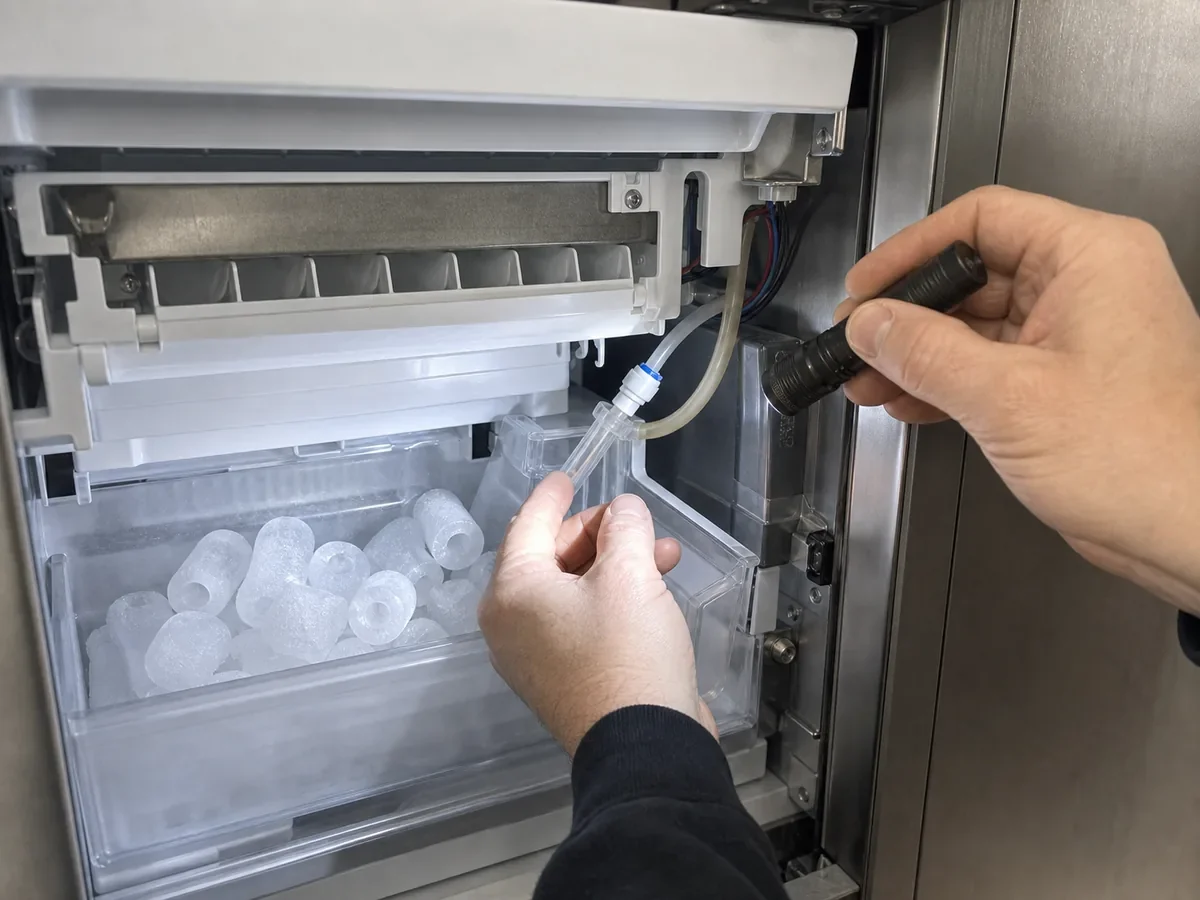
Ice-maker check: fill tube and water line under inspection.
On a 94022 estate the no-ice cause is almost always on the water path, where well and booster supplies behave differently than city water:
Compare planning ranges on the Los Altos Hills repair cost and estate-access page, or use the booking and intake page to have your model and serial ready.
Direct answer
A Sub-Zero making slow ice, hollow cubes, or no ice at all usually has a water-flow problem, not a refrigeration problem. The likely culprits, simplest first: an overdue water filter, a frozen or kinked fill tube, a failing inlet valve, or the icemaker module / thermistor. We rank the cause from your description, then confirm it on site by measuring fill volume and valve operation. Most ice-maker repairs land in the $300–$850 range; the exact quote follows the on-site diagnosis.
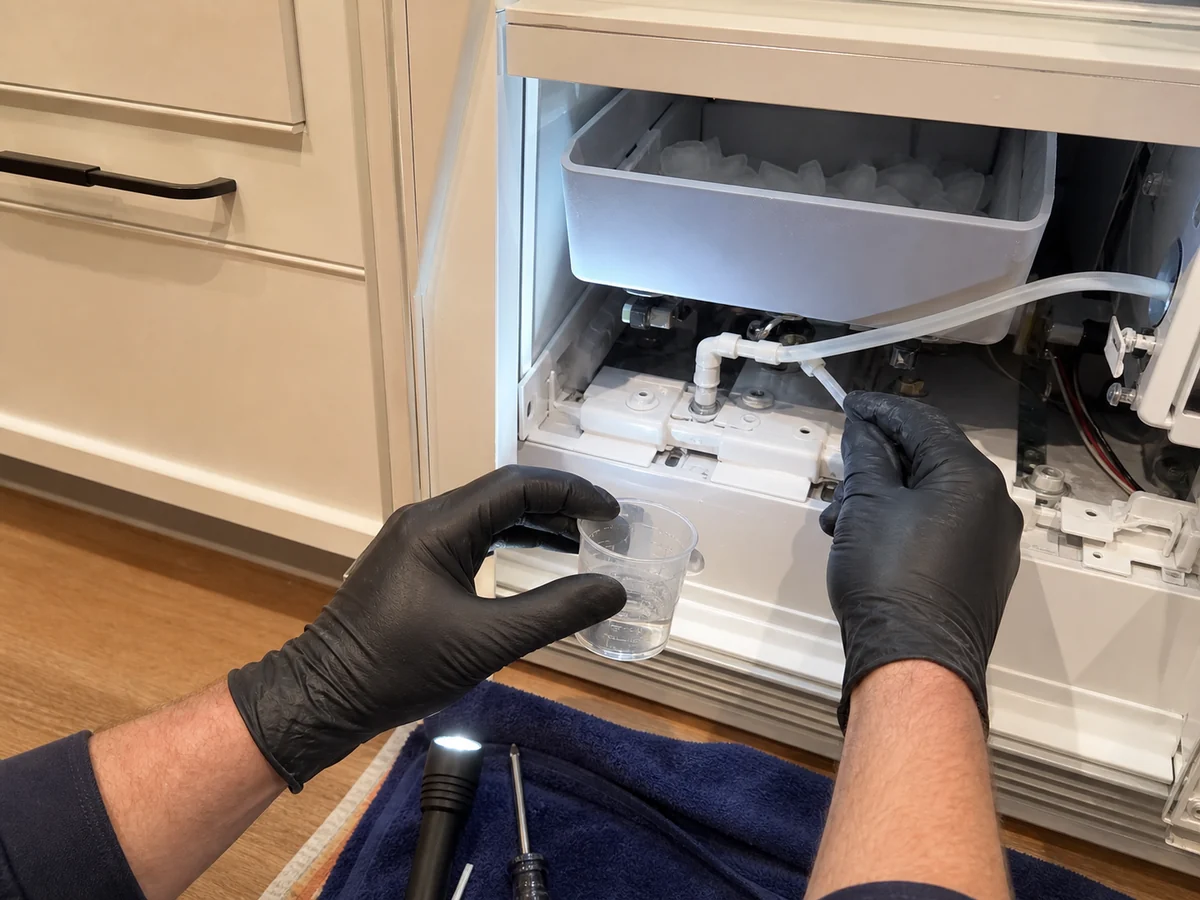
Where the water comes from · Photo band · 01
Before any part gets named, it helps to see what feeds the mold.
Water reaches a Sub-Zero ice maker through a chain of parts, and a fault anywhere on that chain shows up as bad ice. From the household shutoff it passes a water filter, then a solenoid inlet valve that opens for a few seconds each cycle, up through a thin fill tube, into the mold, where a thermistor decides the cubes are frozen and the module ejects them. Hollow or undersized cubes almost always mean the mold isn't filling fully — too little water arrived, or it arrived too slowly. That points up the chain, toward the filter, valve and fill tube, long before it points at the freezer's cooling.
This is the opposite of a sealed-system fault: the freezer can be holding a perfect temperature and still make terrible ice. Caption below explains why the cabinetry matters here.
Normal vs. not · Read this first · 02
Built-in ice makers are slow by design and pause on their own. Knowing the difference saves a service call you may not need.
A Sub-Zero built-in ice maker produces roughly a few pounds of ice a day, not a hotel's worth. It runs a cycle, pauses, and waits for the mold to refreeze. The first 24 hours after a filter change, a move, or a water-line reconnect often produce small or cloudy cubes while the line purges air — that clears on its own. A faint hum and an occasional clatter as cubes drop into the bin are expected.
Watch for hollow or hatchet-thin cubes day after day, ice that fuses into a single jammed block, a bin that stays empty, water pooling under or behind the unit, or a fill cycle you can hear running with no ice to show for it. A burning-electrical smell or repeated ejector grinding means stop and call — forcing the arm can snap the module's gears.
If you see water on the floor or behind the cabinet, shut the water supply to the refrigerator and stop using the ice maker until it's diagnosed — a leaking inlet valve or split fill line can damage flooring and millwork fast in a built-in install. The unit can keep refrigerating safely with the ice maker switched off, so you don't have to lose the whole appliance while you wait.
No ice vs. slow ice · 02b
It is worth splitting the complaint, because "the ice maker isn't working" covers two different failures. No ice at all — an empty bin, a fill cycle you can hear with nothing to show, or a maker that never starts — points hardest at the water getting in: a closed saddle valve, a spent filter, an inlet valve that won't open, or, on the colder end, a module that has stopped cycling. Slow, hollow or clumped ice — cubes that arrive but come out thin, half-formed, or fused into a single block — points at water arriving but not enough of it, or harvesting at the wrong moment: a scaled fill tube, a weak valve, low pressure, or a thermistor timing the eject badly. Both live on the same water path, so they share this page rather than competing for two; the diagnosis simply starts at a different rung of the ranked list below.
The thread running through almost all of it is the local water. If your cubes are cloudy, shrinking or off-tasting, read how Los Altos Hills hard water clogs ice makers — it explains the filter cadence that prevents most of these calls. And if you are also finding water pooling or leaking from the fridge, that is frequently the same hard water working on the inlet valve or the defrost drain, so the two are worth diagnosing together.
Likely causes, ranked · Main diagnosis · 03
We work this list top to bottom, because the cheap fixes are also the common ones. Each row gives the signs, the test that confirms it, and the typical repair on a Sub-Zero.
| Likely cause | Signs you'd notice | How we confirm it | Typical repair |
|---|---|---|---|
| Overdue water filter | Ice volume slowly dropped over weeks; cubes shrinking; sometimes an off taste. Common when the filter is past its 6–12 month life. | Check filter date and flow; compare fill volume before and after bypassing the filter. | Genuine OEM filter; flush the line. Often the whole fix — lowest cost. |
| Frozen or kinked fill tube | Hollow or partial cubes, or none, with the cycle still running. Sometimes a small ice spur at the tube tip. | Inspect the fill tube; measure water actually reaching the mold per cycle. | Thaw and clear, or replace the tube and correct the routing. |
| Low house water pressure / line restriction | Slow fill, thin cubes; sometimes worse after household water use elsewhere. | Measure static and flowing pressure at the valve; check the saddle valve and supply line. | Clear the restriction or correct the supply; rarely a Sub-Zero part at all. |
| Failing inlet (solenoid) valve | Intermittent ice, hollow cubes, or none; occasionally a faint buzz or a slow drip. | Meter the solenoid coil; time the fill and measure volume against spec. | Replace the OEM inlet valve; verify fill volume after. |
| Icemaker module / ejector fault | Cubes jam, don't eject, or the arm grinds; bin stays empty though water arrives. | Test the module's motor and switches; watch a full eject cycle. | Replace the OEM icemaker module assembly. |
| Mold thermistor / harvest sensor | Cubes eject too early (hollow) or too late (fused block); erratic cycle timing. | Read thermistor resistance against the model's reference; observe cycle timing. | Replace the sensor; recheck a full freeze-and-harvest cycle. |
| Control board or display alarm | Ice fault flagged on the display, or no cycle starts despite good water and a good module. | Read the alarm against the model and serial; meter the board's outputs to the ice circuit. | Board repair or OEM replacement — only after the cheaper causes are ruled out. |
An honest limit · 04
A wine column or wine-storage drawer that drifts a few degrees off its set point is a close cousin of these ice faults, and worth a plain explanation because owners often notice it on the same call. A column set to 55°F creeping to 60°F is usually a thermistor reading the cabinet wrong, an evaporator fan slowing down, or a control board acting on a bad number — not the wine going bad and not a dead unit. What confirms it is logging the actual cabinet temperature against the set point over a full cycle and reading the thermistor's resistance, not trusting the front-panel number. The honest limit: from your description we can rank the likely cause, but we cannot tell a marginal valve from a failing module, or a drifting thermistor from a tired fan, until we measure on site. That's why we quote after diagnosis, not before.
Local context · 05
Two local realities shape these visits. First, the water itself: many homes in the 94022 pocket near Foothill College run hard or well-influenced water, which scales filters and inlet valves faster than the maker's manual assumes — so a filter that should last a year is spent in months, and the slow-ice complaint here is more often a flow problem than a failed part. Second, integrated cabinetry: in panel-ready columns and undercounter drawers the water shutoff, filter and inlet valve all sit behind custom fronts, so a leaking valve isn't just an ice problem, it's a millwork problem. We plan access before we touch the unit, because on these built-ins the cabinetry is part of the repair, not an afterthought. Out toward Hidden Villa, where parcels are rural and a service window is a real half-day commitment, we confirm the water-supply setup over the phone first so the right filter and valve are on the truck and the visit isn't lost to a second trip.
What a real diagnosis shows you · Evidence · 06
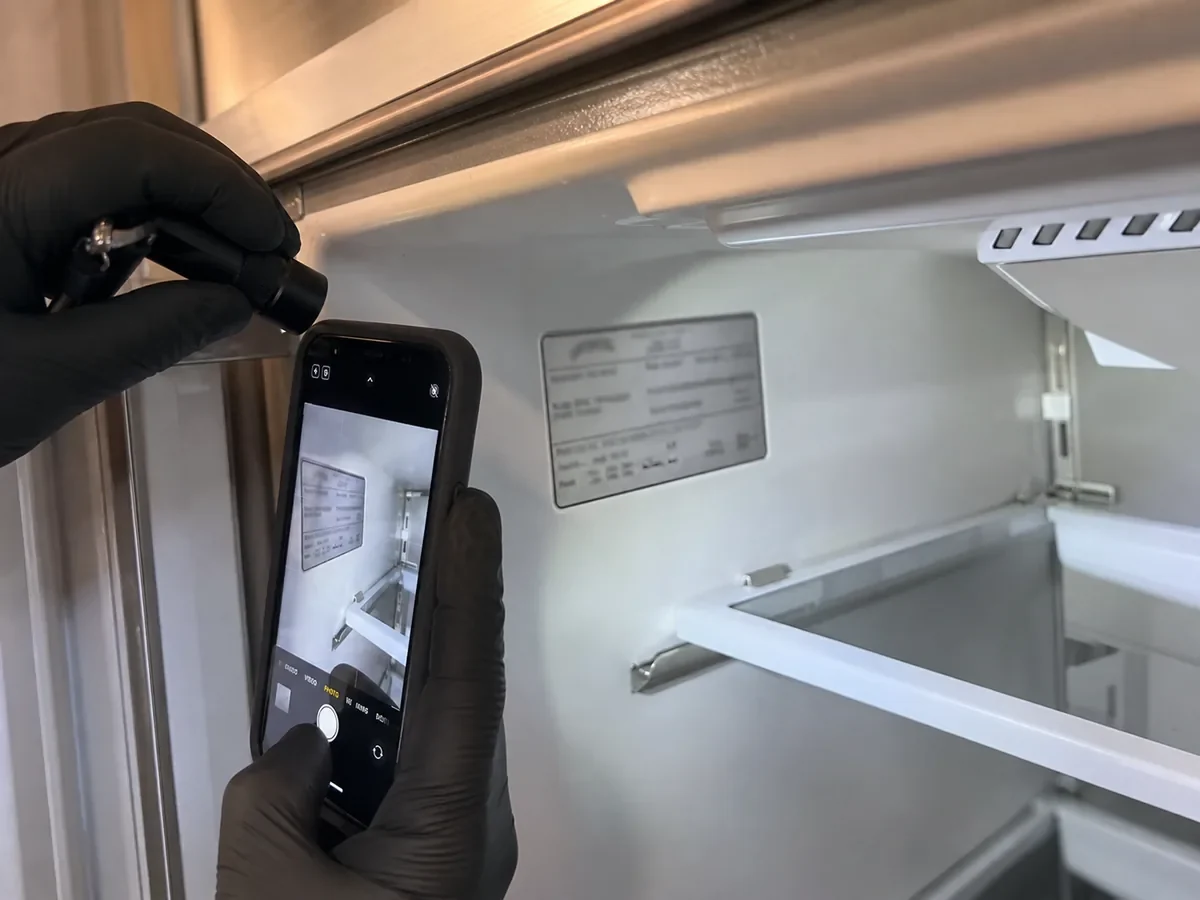
A Sub-Zero ice call should leave evidence, not adjectives: a photo of the part that failed, a reading that proves it, and the wider install it sits in.
Trust & documentation · 07
When an ice fault has survived the cheap fixes and the display is throwing an alarm, we don't reach for the most expensive part first. We read the control board, thermistor or display alarm against the model and serial — not a universal code chart — and we back it with evidence: temperature readings in the freezer and at the mold, condenser and evaporator photos to rule out a frost or airflow problem masquerading as an ice fault, model-tag proof so the part matches the unit, and the OEM valve, module or control-board packaging kept as a record of exactly what went in. A board or thermistor reading wrong can mimic a dead module; metering the board's output to the ice circuit is what tells them apart. Parts are genuine OEM matched to your serial, the invoice names the part and the labor, and a workmanship warranty covers the repair. We don't use 'best parts' language — the serial number, not an adjective, picks the part.
Step by step
Note whether cubes are hollow, thin, slow or absent, and check for water pooling under the unit — each points to a different part of the water path.
Hard Los Altos Hills water clogs filters and fill tubes; a months-overdue filter or kinked tube often explains thin or slow cubes.
On site we measure actual fill volume per cycle and test the inlet valve before replacing the module.
Ice-maker modules and inlet valves vary by serial, so the part is matched to the tag rather than guessed.
A filter and flush runs $120–$230; module, fill tube or valve work $300–$720, confirmed after the $99 diagnostic.
Pricing
| Service / symptom | What's included | Price range | Time |
|---|---|---|---|
| Diagnostic visit | Model/serial ID, temperature + airflow readings, written findings | $99 (credited to repair) | 45–90 min |
| Ice maker module / fill tube / inlet valve | Fill-volume test, valve or module, line clear | $300–$720 | 1–3 hrs |
| Water filter + line flush | OEM filter, line flush, fill-volume recheck | $120–$230 | 30–60 min |
| Thermistor / temperature sensor | Resistance test, serial-matched sensor, recalibration | $280–$560 | 1–2 hrs |
| Control board (serial-matched) | Output test, serial-matched board, verification | $520–$850 | 1–4 hrs |
What sets the final number: the exact model and serial revision, whether the unit must be pulled from its custom cabinet, and parts availability — all confirmed on site after the $99 diagnostic.
After the diagnosis, not before
Call or book online with what the ice is doing — slow, hollow, jammed, or none — and the model/serial number from the tag. We'll rank the likely cause and give you the honest range before the visit, so the truck arrives with the right filter, valve or module already on board.
Questions · 08
Hollow cubes mean the mold isn't filling all the way — water arrived too slowly or in too small an amount. The usual order is an overdue filter, a frozen or kinked fill tube, then a tiring inlet valve, and only sometimes a thermistor harvesting the cubes too early. We confirm by measuring the actual fill volume per cycle on site rather than guessing from the cube shape alone.
Usually not. The ice maker runs off a separate water path, so it can stop while the refrigerator and freezer hold temperature perfectly. No ice points first at the water supply, filter, inlet valve or module — all far less costly than anything on the sealed system. Switch the ice maker off and the unit keeps refrigerating safely until we diagnose it.
Sub-Zero's guidance is roughly every six to twelve months, but with the harder water common in parts of the 94022 area we often see filters spent sooner — slow or shrinking ice is frequently the first sign. A genuine OEM filter matched to your model is the single cheapest thing that fixes weak ice, and it's where we start.
No. Shut the water supply to the refrigerator and switch the ice maker off until it's looked at. A leaking inlet valve or split fill line can damage flooring and the surrounding cabinetry quickly in a built-in install. The refrigerator itself stays safe to run with the ice maker disabled, so you don't lose the appliance while you wait for the visit.
Moderately hard Santa Clara Valley water leaves mineral scale that clouds cubes and dulls taste. A water filter and line flush ($120–$230) usually restores clear ice; if scale has reached the inlet valve or module, that service runs $300–$720. We recommend replacing the filter every 6–12 months locally.
A healthy Sub-Zero ice maker produces a full harvest roughly every 60–90 minutes. If yours is far slower or dropping thin cubes, the usual local cause is a clogged fill tube or tired inlet valve from hard water. We measure actual fill volume per cycle before replacing parts, with module work at $300–$720.
Keep reading
Local review signal
Owners usually care about the same three things: careful diagnosis, protected cabinetry and a quote that follows evidence.
Our BI-42SID dropped thin, hollow cubes after the hard water clogged the fill tube. The tech cleared it, swapped the inlet valve and flushed the line in under two hours. Full cubes by the next morning.
Laura B., Homeowner, Fremont HillsThe ice maker on our 648PRO quit completely. A months-overdue filter plus a tired module; the filter flush and module service took about 90 minutes. They pointed to the local water hardness as the real culprit and suggested a filter schedule.
Raymond S., Homeowner, SpringcrestHollow cubes and water pooling under our UC-15I turned out to be a cracked fill tube. They replaced it and verified fill volume over each cycle. No upsell to a new unit, which I half expected.
Karen W., Homeowner, Matadero Hills