Both sides of our 648PRO went warm and the compressor never cycled off. They verified pressures under EPA 608 before quoting — a refrigerant leak, sealed and recharged for $1,700. Holding 38 °F since.
Homeowner, Country ClubClimate care field guide · Sealed system & compressor
Is it really the sealed system on your Sub-Zero — or a packed condenser?
When both compartments of a Los Altos Hills Sub-Zero go warm and the compressor runs without ever shutting off, owners assume the sealed system has failed. Out toward the Hidden Villa area, where oak litter and pet hair settle into the grille, the far more common cause is a condenser coil packed with dust or pet hair — the compressor is fine, it just can't shed heat. A true sealed-system or refrigerant fault is the one Sub-Zero failure that needs qualified sealed-system verification before anyone quotes it.
We are a Sub-Zero-focused service. This page explains how the two get told apart, and what we will not guess.
Sealed-system and refrigerant work follows EPA Section 608.

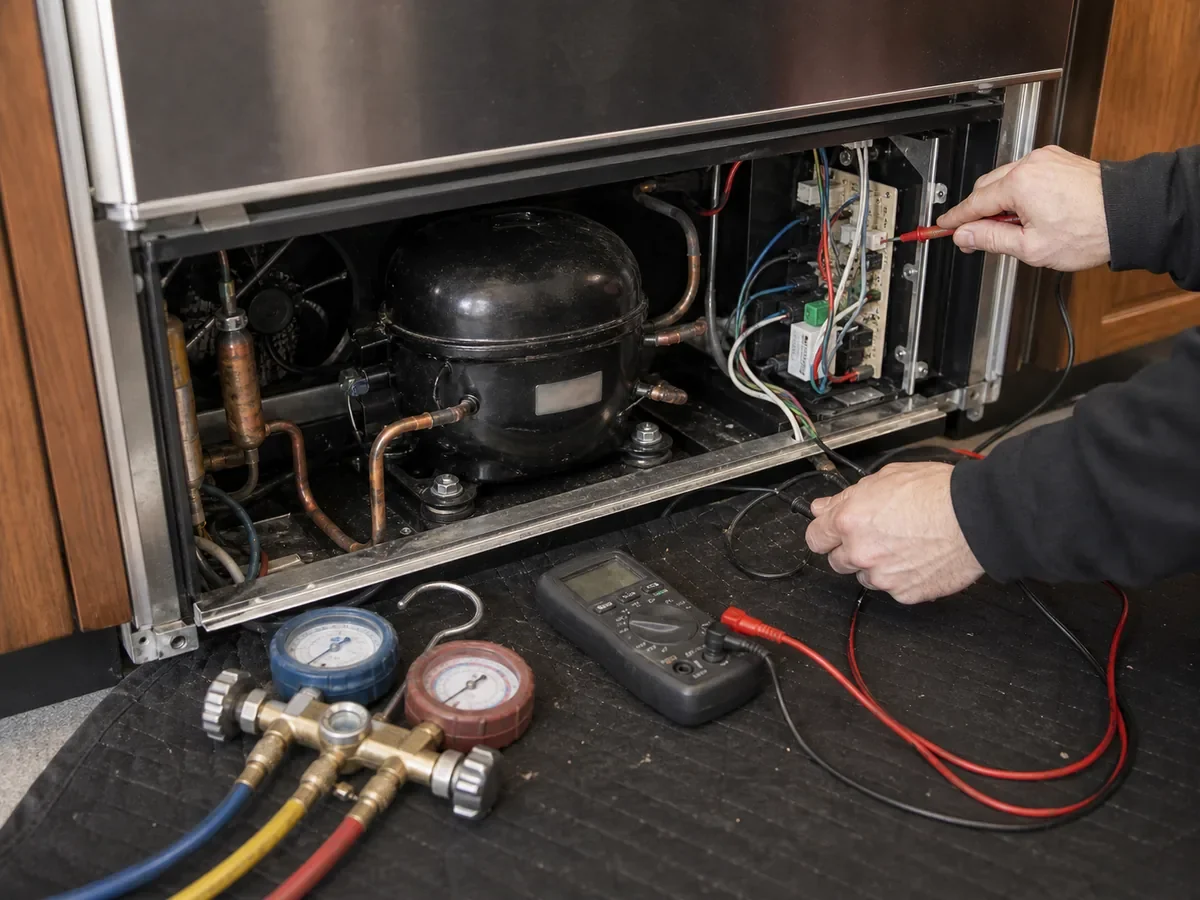
Sealed-system evidence: meter and gauge readings before a quote.
Direct answer
A Sub-Zero with both sides warm and a compressor that never cycles off is the only symptom that can mean a sealed-system or compressor fault — and the only one we refuse to quote without an EPA Section 608 verification. Most of the time the real cause is cheaper: a condenser coil choked with dust, a stalled condenser fan, or a control reading the cabinet wrong. A flat $99 diagnostic is credited toward any approved repair. If it truly is the sealed system or compressor, that work runs $1,400–$2,900; everything short of it usually lands $300–$850. Exact figures come in writing after on-site diagnosis.
- Sub-Zero sealed-system repair in Los Altos Hills: refrigerant leak + recharge $1,400–$2,100, compressor replacement $1,900–$2,900, after the $99 diagnostic.
- Both compartments warm with a compressor that never cycles off is the one pattern that can mean sealed-system trouble — but a dust-packed condenser ($230–$460 to clear) mimics it.
- Sealed-system and refrigerant work is performed under EPA Section 608 handling and quoted only with gauge or leak evidence.

01 · Why we lead with the photo
The most expensive Sub-Zero misdiagnosis starts at the grille
Caption first, because the picture is the argument: hillside homes under oak are where a packed condenser most often imitates a dead sealed system.
What you're looking at. A foothill home under a live oak at dusk — illustrative local context, not a job we did. The point is the oak: across the Los Altos Hills ridgelines, fine oak litter, pollen and pet hair drift into the condenser grille at the top of a built-in Sub-Zero. Within a season the coil can carry a felt of debris thick enough that the compressor runs continuously and still loses ground. Both compartments creep warm. To an owner — and to a generalist — that reads exactly like a failing sealed system.
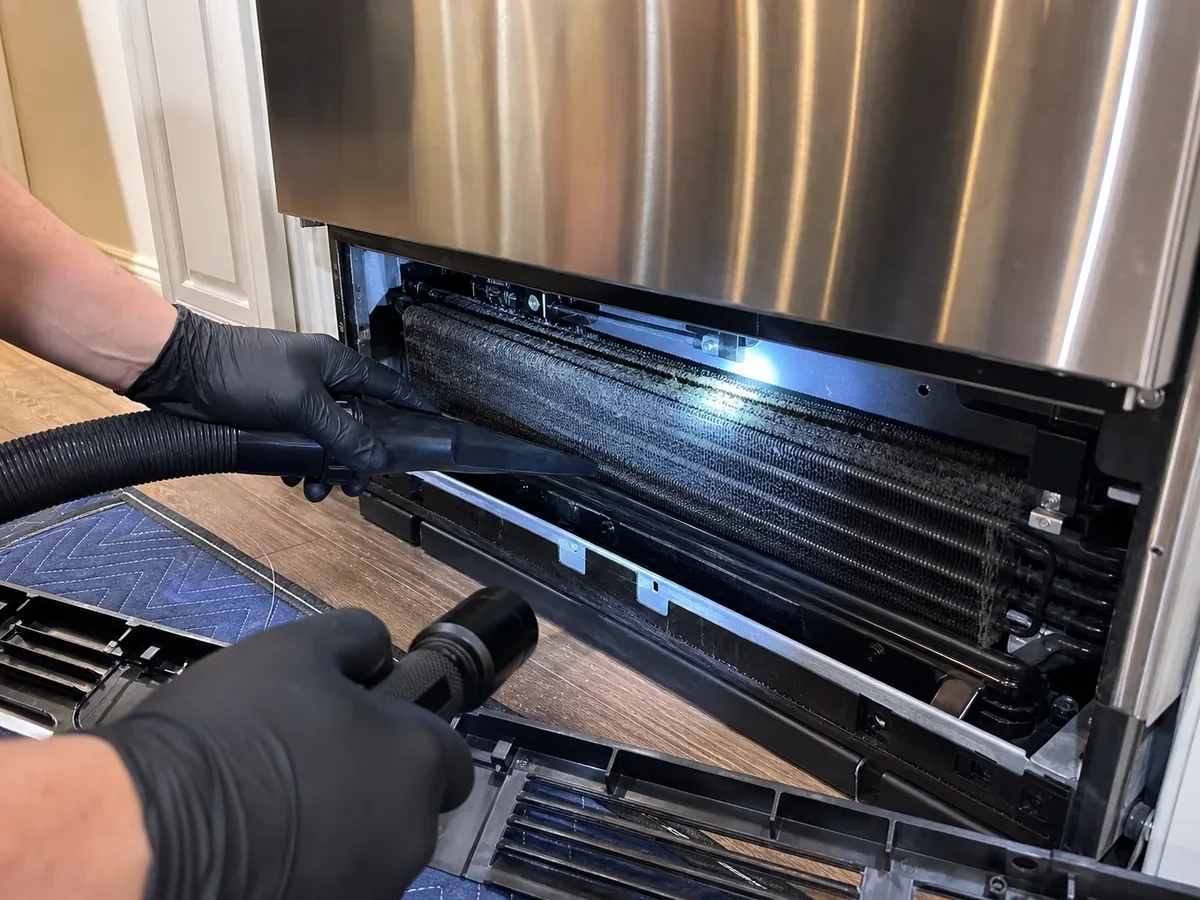
It usually isn't. A condenser coil packed with dust or pet hair is the single most common avoidable cause of a "both sides warm" Sub-Zero call up here, and it is a brush, a vacuum and a fan check away from confirmed — not a refrigerant job. We separate the two on site before a single price is named, because guessing wrong on this symptom is the difference between an $85 cleaning and a $2,900 sealed-system repair.
Second suspect · 02
The frost line and the sweating door — and the one thing it can't tell us yet
A door gasket leak shows up as condensation or a frost line long before it shows up as a warm cabinet. On a Sub-Zero built-in, watch the top corners and the strike side of the door: a hardened or torn gasket lets warm, humid room air seep in, and that moisture either beads as a sweat track down the panel or freezes into a thin frost ridge where it meets the cold seal. A flashlight at the gasket edge and a slip of paper that pulls free too easily are the homeowner's first tells.
What confirms it on our end is a gasket inspection against the door frame plus a check of door alignment behind the panel — a sagged hinge or a panel reseated a few millimeters proud will mimic a bad gasket. Here is the honest limit: a frost line and a long-running compressor can both be true at once. We cannot know from the doorway whether the gasket is the whole story or whether a tired gasket is simply loading a sealed system that was already marginal. That separation needs temperature logging and, if pressures stay suspect, gauges — not a guess from the kitchen floor.
You can safely clean the condenser grille, confirm the condenser fan spins, check the door gasket, and listen for whether the compressor is running. Stop there. Opening the sealed refrigeration loop — recovering refrigerant, brazing a leak, replacing a compressor, dryer or evaporator — is regulated under EPA Section 608 and requires qualified handling and recovery equipment. Venting refrigerant is illegal, and a mis-charged or contaminated system fails again fast. We do not quote sealed-system work from symptoms alone: we verify with gauges and meter readings first, or we tell you it needs that step before any number is real.
How the suspects get separated · Diagnostic table · 03
Symptom, suspect component, the test that confirms it, and the false positive that fools people
Every row pairs a real Sub-Zero symptom with the component it points at, the on-site test that confirms it, the false positive we rule out first, and where the repair goes. Read the false-positive column hardest — it is where the costly mistakes hide.
| Symptom | Possible component | Confirmation test | False positive to avoid | Repair path |
|---|---|---|---|---|
| Both sides slowly warm, compressor runs constantly | Condenser coil packed with dust / pet hair | Inspect grille; measure condenser inlet vs outlet air temp; check coil cleanliness | Calling it a dead sealed system before the coil is even cleaned | Clean coil, re-measure; only escalate if heat rejection stays poor |
| Compressor runs but cabinet never reaches set point | Stalled or weak condenser fan | Confirm fan spins at speed; check airflow across the coil | Blaming low refrigerant when airflow is the real loss | Replace condenser fan / motor; verify recovery of temps |
| Both sides warm, compressor warm but airflow good | Refrigerant undercharge or slow leak | EPA Section 608 compliant gauge set; compare suction/discharge pressures to spec | Adding refrigerant without finding the leak first | Leak isolation, repair, evacuate and recharge to spec (608) |
| Compressor hums, clicks, won't start, then trips | Failed start relay / capacitor or seized compressor | Meter the relay and windings; listen for lockout cycling | Condemning the compressor when a $40 relay is the fault | Replace relay/cap first; replace compressor only if windings fail |
| Warm with frost or oil film near tubing / brazed joints | Sealed-system leak at a joint or dryer | Electronic leak detector; trace oil residue; pressure hold test | Mistaking door-gasket condensation for an internal leak | Repair joint, replace dryer, evacuate, recharge (608) |
| One zone fine, the other warm on a dual-refrig unit | Single failed sealed circuit or that side's evap fan | Isolate by zone; check the suspect side's fan and coil frost | Treating a dual-refrig Sub-Zero as one shared system | Repair only the affected circuit / component |
| Frost line, sweating door, but cabinet still cold-ish | Door gasket / alignment behind the panel | Gasket seal and paper-pull test; check door and hinge alignment | Opening the sealed system over what is a gasket leak | Replace gasket, realign door; re-test seal |
| Display reads warm; compressor cycles oddly | Thermistor or control board misreading the cabinet | Compare thermistor resistance to temp; verify against actual readings | Quoting a compressor off an error code alone | Replace sensor or board after model/serial confirmation |

It depends on the unit · Model families · 04
Where the sealed system lives differs by Sub-Zero family
These are general service notes by family. Exact pressures, refrigerant type and board revisions are not listed here — those we read off your model and serial on site, because publishing a number we can't tie to your unit would be a guess.
Classic / BI built-ins
The long-running built-ins (BI-36, BI-42, BI-48 and kin) use dual refrigeration — two separate sealed systems, so one circuit can fail while the other holds. That split is a gift: it lets us isolate which loop is suspect instead of condemning the whole unit. Verify the exact circuit and refrigerant by model/serial before any sealed-system step.
Designer integrated columns
Integrated refrigerator and freezer columns (the panel-ready successors) run independent systems too, but the access and the model-tag location differ from Classic. The cabinetry is tighter, so a sealed-system pull is planned around the millwork. Confirm the column's refrigerant and board revision by serial, not by family assumption.
PRO 48 / large built-ins
The PRO and larger built-ins carry heavier refrigeration and a more demanding condenser load — exactly the unit that suffers most when the coil packs with oak litter. We check heat rejection before pressures here. Compressor and relay specifics are verified against the serial.
UC undercounter refrigerators & drawers
Undercounter UC refrigerators and freezer drawers run compact sealed systems in a tight bay, so airflow starvation and a weak fan imitate a refrigerant fault more often than on full columns. Diagnose airflow and fan first; verify the sealed-system details by model/serial.
424 / 427 / 430 wine units
Wine columns run their own cooling, and a few degrees of drift is rarely the sealed system — it's usually a thermistor, fan or control. We log a full cycle before naming a refrigerant fault, because a wine unit's complaint is drift, not a dead box. Refrigerant work, if needed, still follows 608.
Why "verify by model/serial" is not a dodge
Across these families the refrigerant type, charge weight and board revision genuinely differ — and the serial dates the sealed system and any factory revisions. A pressure spec that's right for one BI vintage is wrong for the next. We read the tag in person so the diagnosis matches your unit, not a chart.
The sealed system, in plain terms · How the loop works · 05
What is actually inside the system we won't open on a guess
Reading the loop · 06
Why one schematic stops us condemning the wrong part
Follow the loop and the misdiagnosis explains itself. The compressor pumps refrigerant; the condenser coil dumps the heat to the kitchen air; the metering device drops the pressure so the evaporator can pull heat back out of the cabinet. If the condenser can't reject heat — because it's blanketed in oak litter, or the fan stalled — the compressor labors and the cabinet stays warm with a perfectly healthy sealed system. Pressures only get read once airflow and heat rejection are proven good, so we don't chase a refrigerant ghost.
When pressures genuinely come back wrong — a low charge, a restriction at the dryer, a leak at a brazed joint — that is the EPA Section 608 compliant path: recover, repair, evacuate, recharge to the spec tied to your serial. It is the costliest Sub-Zero repair, and the one most worth verifying twice. Out on the Altamont ridge, where homeowners run wine columns and cellars and temperature stability is the whole point, we log a full cycle and confirm pressures before we name a sealed-system fault — drift complaints there earn evidence, not a fast quote.
Local service note · 07
Why the Page Mill corridor loads condensers faster than the valley floor
The single environmental factor that most changes a sealed-system call here is the route. Foothill homes climbing the Page Mill corridor sit under mature oaks on parcels with long, often steep private drives. Two things follow. First, the oak canopy and the fine dust kicked up off unpaved or semi-rural approaches pack exposed condensers faster than almost anywhere on the valley floor — so "both sides warm" calls cluster on this route, and most resolve at the grille, not the gauge set. Second, the access itself shapes scheduling: a gated, switchbacked drive means we confirm the gate code and a precise arrival window so a sealed-system diagnosis, which can run long, isn't lost to a missed entry. We tell Page Mill owners plainly that a twice-a-year coil cleaning prevents more of these calls than any part we carry.
What proof looks like · 08
The evidence behind a sealed-system suspicion — before any qualified sealed-system verification
A sealed-system suspicion that needs qualified sealed-system verification should never rest on a hunch, so we leave a trail before we ever connect gauges. We capture temperature readings in both compartments to show the system isn't holding; we photograph the condenser and evaporator so you can see whether the coil is choked or clear and whether the evaporator is frosting; we record the model-tag so the refrigerant, charge and board revision are matched to your exact serial; and when a part is replaced, we keep the OEM fan, gasket or control-board packaging as proof of what went in. Only after that evidence still points at the sealed system do we move to the EPA Section 608 step — gauge pressures, leak detection, recovery — and document those readings too. The verification is the product here: you see why the system is suspect before you approve the most expensive repair a Sub-Zero can need.
The model and serial number are not paperwork — on a sealed-system call they are the difference between a real diagnosis and a guess. The model tells us the family, the refrigeration layout and which board revisions exist. The serial dates the sealed system, identifies the refrigerant and charge, and flags any factory revision to the compressor or control. Two Sub-Zeros that look identical behind matching panels can take different parts and different pressure specs.
Before you reach for the phone, photograph the tag (look inside the upper door frame or the interior side wall) and note what the unit is doing and when it started. With the model, the serial and a clear symptom, we can rank the likely cause and tell you whether the truck needs to carry recovery equipment for an qualified sealed-system verification — instead of a return trip. That single photo shortens the diagnosis and keeps the quote honest.
Step by step
Diagnose a Sub-Zero sealed-system or compressor fault
Confirm both sides are warm
A warm fresh-food and freezer with a compressor that never cycles off is the one pattern that can mean sealed-system trouble.
Rule out the condenser
A dust-packed condenser mimics sealed-system failure; clearing it ($230–$460) resolves many "compressor" calls in the foothills.
Test electrical and pressures
We verify compressor draw and, only if needed, sealed-system pressures under EPA 608 handling.
Decide repair vs replace
Refrigerant leak repair runs $1,400–$2,100 and compressor replacement $1,900–$2,900; we weigh it against unit age and cabinetry.
Approve with evidence
No sealed-system work is quoted without gauge or leak evidence, after the $99 diagnostic.
Pricing
Sub-Zero sealed-system & compressor pricing in Los Altos Hills
| Service / symptom | What's included | Price range | Time |
|---|---|---|---|
| Diagnostic visit | Model/serial ID, temperature + airflow readings, written findings | $99 (credited to repair) | 45–90 min |
| Condenser deep-clean & airflow service | Pull-free coil clean, fan check, oak-pollen/dust removal | $230–$460 | 1–2 hrs |
| Control board (serial-matched) | Output test, serial-matched board, verification | $520–$850 | 1–4 hrs |
| Refrigerant leak + recharge (EPA 608) | Leak isolation, repair, evacuate and weighed charge | $1,400–$2,100 | 3–6 hrs |
| Compressor replacement | Sealed-system pull, compressor, filter-drier, recharge | $1,900–$2,900 | 4–8 hrs + parts |
What sets the final number: the exact model and serial revision, whether the unit must be pulled from its custom cabinet, and parts availability — all confirmed on site after the $99 diagnostic.
After the diagnosis, never before
Request Los Altos Hills diagnostic window
Call or book online to request a Los Altos Hills diagnostic window. We'll tell you whether the visit is likely to start at a packed condenser, a gasket, or a genuine sealed-system suspicion that needs qualified sealed-system verification. The flat $99 diagnostic is credited toward any approved repair.
Questions · 09
Sealed-system and compressor questions we actually field
Both sides of my Sub-Zero are warm and the compressor never shuts off — is the compressor dead?
Not necessarily, and that's the whole point of this page. A compressor that runs constantly while the cabinet stays warm is most often a heat-rejection problem — a condenser coil packed with dust or pet hair, or a stalled condenser fan — not a failed compressor or low refrigerant. We confirm airflow and clean the coil before reading pressures. Only if heat rejection is proven good and pressures still come back wrong do we treat it as a sealed-system fault.
Can you just add refrigerant to my Sub-Zero?
No — and any tech who offers to 'top it off' without finding the leak is selling you a repeat failure. A sealed system is a closed loop; if it's low, refrigerant escaped somewhere. Under EPA Section 608 we isolate and repair the leak, evacuate the system, then recharge to the spec tied to your serial. Recharging without repairing the leak is both ineffective and against the rules.
Why won't you give me a sealed-system price over the phone?
Because honestly we can't know yet. Roughly half of 'both sides warm' calls in the foothills resolve at the condenser grille for far less than a refrigerant job. Until we verify airflow, pressures and the leak path on site, any sealed-system number would be a guess. We quote in writing after the qualified sealed-system verification — sealed-system and compressor work runs $1,400–$2,900, but only once it's confirmed as the real fault.
Is a 15-year-old Sub-Zero with a sealed-system fault worth repairing?
Often, but it's the one repair where replacement deserves a real look — sealed-system work is the costliest Sub-Zero fix, and on a sound cabinet it can still beat replacement plus cabinetry rework. We weigh the unit's age, the rest of the system's condition and the cabinetry impact, and we'll tell you when replacement is the smarter call. See our repair-vs-replace framework for how we score it.
Why won’t you quote a Sub-Zero compressor over the phone?
Because the symptom that sounds like a dead compressor — both sides warm, unit running constantly — is just as often a dust-packed condenser ($230–$460 to clear) in Los Altos Hills. We verify airflow, electrical draw and, only if needed, sealed-system pressures under EPA 608 before quoting. Confirmed compressor work runs $1,900–$2,900.
Is a 15-year-old Sub-Zero with a sealed-system fault worth fixing?
Often yes, if the cabinet and cabinetry are sound. A refrigerant leak repair ($1,400–$2,100) or compressor replacement ($1,900–$2,900) on a Classic built-in still costs far less than $9,000–$18,000+ to replace with new millwork. We give you the evidence and the honest comparison before you decide.
Keep reading
Where to go next
Local review signal
Google review highlights for Sub-Zero sealed-system and compressor diagnosis in Los Altos Hills
Owners usually care about the same three things: careful diagnosis, protected cabinetry and a quote that follows evidence.
Estate-kitchen BI-48 had a confirmed compressor failure after airflow and electrical were ruled out. Replacement ran $2,400 over a long afternoon — still cheaper than a new built-in plus cabinetry.
Estate manager, AltamontI feared the worst on a 15-year-old BI-36, but the 'sealed-system' symptom was a dust-packed condenser. A deep clean for $430 fixed it. They didn't sell me a compressor I didn't need.
Homeowner, Fremont Hills