
On the ridgelines above Los Altos Hills, a built-in wine column is rarely a novelty — it's where a collection that took years to assemble actually lives. So when a Sub-Zero wine unit starts reading two or three degrees warm, the worry isn't the appliance. It's the bottles.
Sub-Zero builds integrated wine storage to hold a far tighter band than a kitchen refrigerator, and that precision is exactly what makes a drift worth taking seriously. Here's what tends to go wrong in the foothill estates we service, and why most of it is fixable long before a cellar is lost.
Dual-zone control, and why the red side slips first
A dual-zone Sub-Zero wine column runs two independent climates from one cabinet — a cooler upper band for whites and sparkling, a warmer lower band for reds — each governed by its own sensor and damper. That balancing act is the part that drifts. When a zone sensor ages or the damper that meters cold air between compartments sticks, the unit chases a target it can no longer read accurately, and one zone wanders while the other holds.
We see the warmer red zone go off-target most often, because it depends on the unit blending and throttling cold air rather than simply making more of it. The tell is a column that keeps the whites honest but lets the reds creep up a few degrees by evening. That points us at the zone sensor and damper before anything deeper.
The sealed system, the condenser, and a hot foothill summer
Underneath the zone controls is the same kind of sealed refrigeration system as a built-in fridge — compressor, evaporator, and a condenser that has to dump heat into the room. Up here, where dry inland afternoons run hotter than the coast and a wine column is often boxed into custom millwork beside a refrigerator and a range, that condenser loads with dust and loses airflow. A starved condenser is the quiet cause behind a lot of summer warm-drift calls, and it's a cleaning, not a teardown.
The deeper sealed-system faults — a tired compressor or a slow refrigerant leak — are real but rarer, and they read differently on a gauge than a control problem does. We measure before we diagnose, so a damper issue never gets treated as a compressor.
Seals, vibration, and what we check on a wine unit
Two things matter on a wine column that don't on a freezer. The door gasket and UV-tinted glass seal keep stable, humidified air in and warm room air and light out; a gasket that has hardened or a glass seal that has let go shows up as a unit running constantly and still drifting. And vibration — a worn fan bearing or a compressor mount gone hard — does more than make noise. Sustained vibration disturbs sediment in older reds, which is its own kind of damage in a serious cellar.
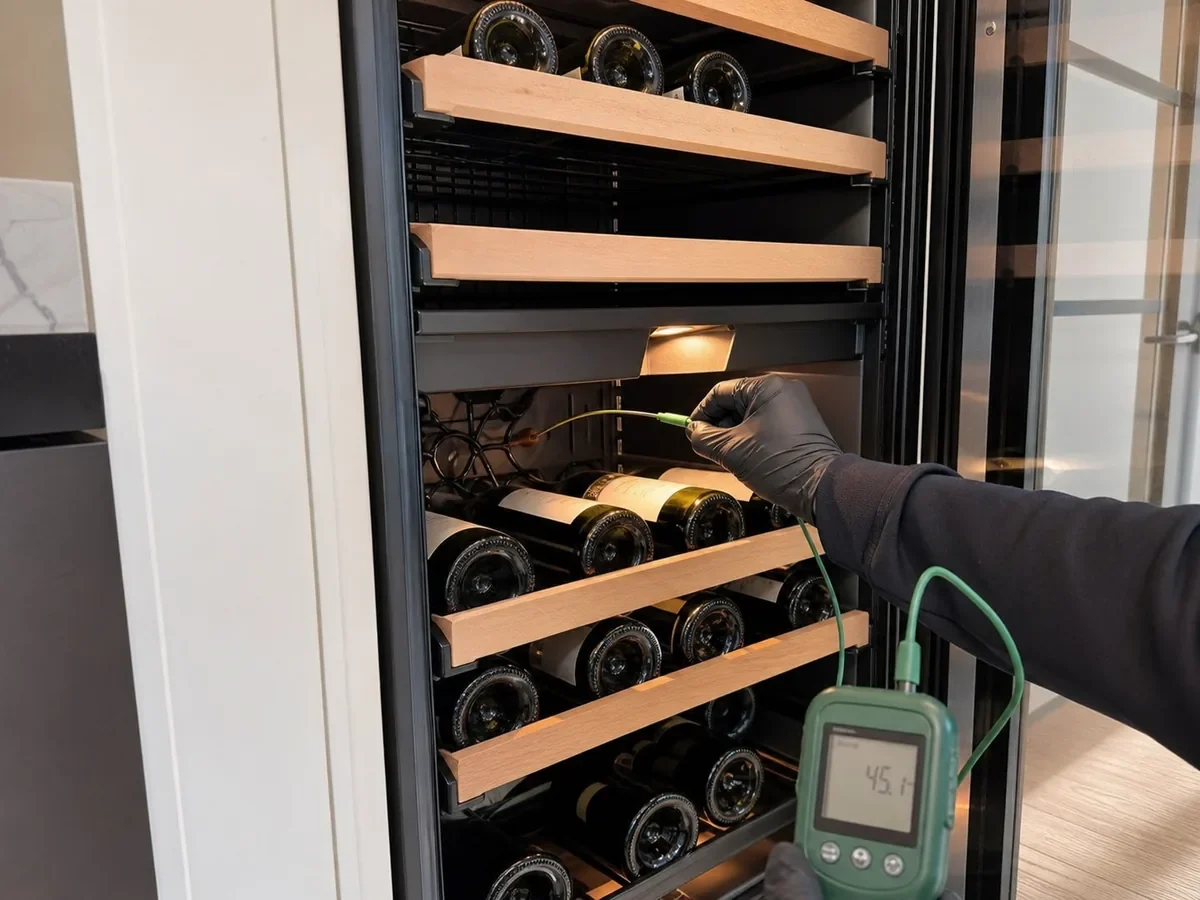
When we come out, we check the zone sensors and dampers, clean and read the condenser, test the evaporator fan, and inspect the gasket and glass seal as one visit. On most Los Altos Hills wine columns the fix is a sensor, a damper, a fan, or a gasket — bounded repairs on a unit worth keeping. We'll only raise replacement if a sealed-system bill on an aging cabinet stops making sense, and we'll show you the readings if it does. The $89 diagnostic goes toward the repair; call or book online.